Cold Email Deliverability: The Complete 2026 Guide
The 2026 cold email deliverability guide covering domains, SPF, DKIM, DMARC, warm-up, mailbox rotation, and the metrics that keep you out of spam.

Cold email deliverability is the difference between an outbound program that books meetings and one that quietly sends nothing. Here is the uncomfortable truth most teams learn too late: open rate is a property of your deliverability, not your copy. You can write the best cold email in the world, and if your infrastructure is wrong, a human never sees it.
In 2026 this matters more than ever, because the ground shifted. Mailbox providers went from quietly filtering non-compliant senders to rejecting them outright. Google and Yahoo now enforce authentication requirements they used to merely recommend, and the organizations that maintain email blocklists have published formal positions treating most modern cold outreach as spam. None of this makes cold email illegal or ineffective. It changes what a program has to look like to survive.
We build outbound infrastructure for B2B companies, so deliverability is something we tune constantly rather than theorize about. This guide covers what deliverability actually is, the domain and authentication setup that forms the foundation, mailbox warm-up, the volume and rotation rules that keep you safe, the data hygiene that prevents most damage, the metrics that predict problems, and how to recover a burned domain.
For the broader channel context, see our cold email guide. For the discipline behind building this infrastructure, see our GTM engineering guide.
What Is Cold Email Deliverability?
Cold email deliverability is whether your emails actually reach the recipient's primary inbox rather than landing in spam, promotions, or being rejected outright by the receiving server. It is worth separating two things that get conflated: delivery and inbox placement.
Delivery is whether the receiving server accepted the email at all. Inbox placement is whether the accepted email landed in the primary inbox versus spam or promotions. A program can have high delivery and terrible inbox placement, which is the silent killer: the emails are technically delivered, the dashboard looks fine, and yet almost nobody sees them because they all land in spam. Inbox placement is what actually matters, and it is invisible on most sending dashboards.
The reason deliverability sits upstream of everything else is that modern spam filters weigh how recipients behave far more heavily than what a message says. Opens, replies, deletions, and spam complaints all feed the algorithm that decides where your future emails land. This creates a compounding dynamic: good sending behavior earns better placement, which earns more engagement, which earns better placement still. Bad behavior spirals the same way in reverse. Deliverability is therefore not a one-time setup but an ongoing discipline that either compounds in your favor or against you.
Domain Setup: The Foundation
Everything in deliverability starts with domain architecture, and getting it wrong here is the most common and most damaging mistake.
The cardinal rule: never send cold email from your primary business domain. Use dedicated sending domains separate from the domain your company runs its real email on. If you send cold outreach from yourcompany.com and the domain's reputation takes a hit, your entire company's email, including invoices, customer conversations, and internal mail, suffers with it. Instead, register separate sending domains (variations like getyourcompany.com or yourcompany.io) and send from subdomains or mailboxes on those.
The standard architecture for a serious cold email program uses multiple sending domains, each hosting a few mailboxes, all pointing back to your main site but insulated from your primary domain's reputation. This isolation is what lets you scale volume and take the inevitable occasional reputation hit without collateral damage to business-critical email. It is also what makes recovery possible: if one sending domain gets burned, you retire it and continue on the others rather than losing your company's entire email capability.
When you register sending domains, give them time to age before heavy sending, set up proper redirects to your main site, and configure authentication before a single cold email goes out. A brand-new domain sending cold volume on day one is a near-guaranteed spam classification.
SPF, DKIM, and DMARC: Email Authentication
Authentication is the set of DNS records that prove your emails are genuinely from you and not spoofed. In 2026, mailbox providers enforce these rather than treating them as optional, so misconfiguration here is disqualifying.
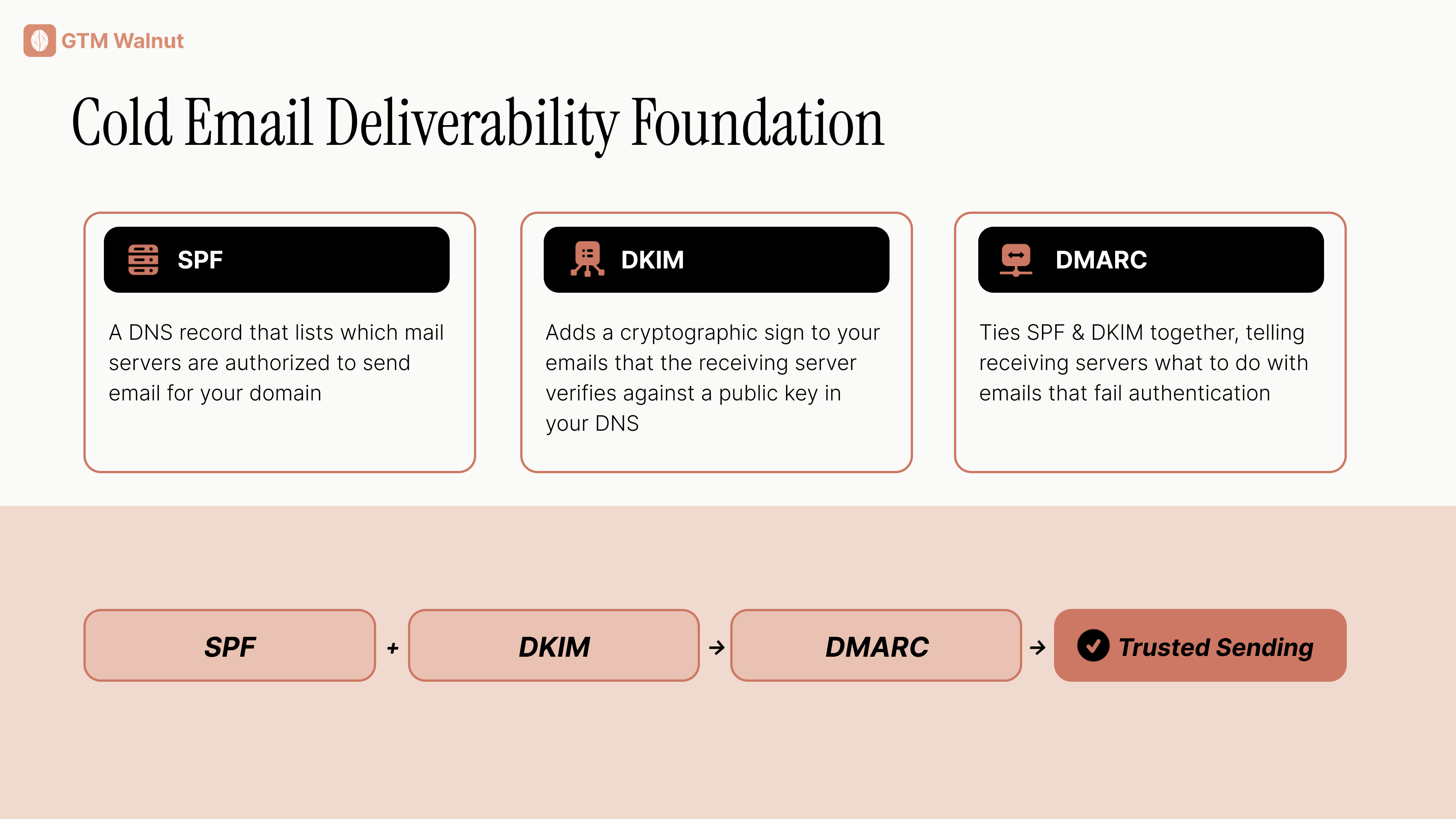
SPF (Sender Policy Framework) is a DNS record that lists which mail servers are authorized to send email for your domain. When a receiving server gets your email, it checks whether the sending server is on your SPF list. If it is not, the email looks spoofed and gets penalized or rejected.
DKIM (DomainKeys Identified Mail) adds a cryptographic signature to your emails that the receiving server verifies against a public key in your DNS. It proves the email was not tampered with in transit and genuinely came from your domain.
DMARC (Domain-based Message Authentication, Reporting, and Conformance) ties SPF and DKIM together, telling receiving servers what to do with emails that fail authentication and giving you reporting on who is sending mail using your domain.
The practical requirement for 2026 is simple to state: every sending domain needs all three configured correctly before you send. Google's Gmail sender guidelines now require authentication for bulk senders, and messages failing these checks are increasingly rejected rather than filtered. This is not the interesting part of cold email, but it is the part that silently determines whether anything else you do matters. Get all three right on every sending domain, verify them with a testing tool, and never launch a domain without them.
Mailbox Warm-Up
A brand-new mailbox that immediately starts sending cold volume looks exactly like a spammer to mailbox providers, because that is precisely the behavior spammers exhibit. Warm-up is the process of building a sending reputation gradually so your mailbox earns trust before it sends cold outreach.
The process works by simulating and generating genuine positive engagement. Warm-up tools, built into platforms like Instantly and Smartlead, connect your new mailbox to a network of real accounts that send emails back and forth, open them, reply, and mark them as important. This teaches mailbox providers that your mailbox sends wanted mail that people engage with, building the reputation that earns inbox placement.
The timeline matters. A proper warm-up ramps gradually: 10 to 25 emails per day in weeks one and two focused on the contacts most likely to reply, increasing to 25 to 50 per day in weeks three and four while introducing cold prospects slowly, and scaling to target volume over weeks five and six. Throughout, watch bounce rates (keep under 2%) and spam complaints (under 0.1% during warm-up), and if either spikes, reduce volume immediately. Rushing warm-up is one of the most common ways programs torch a domain before they have sent a single real campaign. Warm-up is also not purely a launch activity; keeping some background warm-up running continuously helps maintain reputation over the life of the mailbox.
Volume Limits and Mailbox Rotation
Volume discipline is where deliverability is won or lost at scale, and the rules are specific enough to state precisely.
The safe sending limit in 2026 is 50 to 100 cold emails per mailbox per day. Consistently exceeding 100 per mailbox degrades sender reputation and triggers rate limiting and spam classification from mailbox providers. This ceiling is not a suggestion; it reflects the volume patterns that filters use to distinguish legitimate senders from spammers.
The implication is that you scale volume horizontally, through more mailboxes, not vertically through higher per-mailbox volume. This is mailbox rotation: running three to five warmed mailboxes per SDR, spreading sends across all of them, which puts total daily volume at a safe 200 to 375 emails per SDR. To send 2,000 cold emails a day, you do not push 20 mailboxes to their limit; you run enough warmed mailboxes across enough sending domains that each one stays comfortably within the safe range.
This is the entire infrastructure game at scale, and it is why serious outbound operations provision and warm dozens of mailboxes across multiple domains. Each mailbox stays under its limit, each domain hosts a manageable number of mailboxes, and the load spreads so that no single mailbox or domain carries enough volume to trigger filtering. Rotation also builds resilience: if one mailbox or domain has a problem, the others keep the program running while you fix or retire it.
Data Hygiene: Where Most Damage Starts
Good deliverability starts with who you email, and this is where most damage actually originates. You can have perfect infrastructure and still burn a domain by sending to a bad list.
The core discipline is list quality. Build lists rather than buying them blind, because scraped and bulk-purchased lead lists carry spam traps (addresses specifically planted to catch spammers), role addresses (info@, sales@) that generate complaints, and dead accounts that bounce. A single spam trap hit can damage a domain's reputation significantly. If you use a data provider, use one that verifies and refreshes its data rather than selling stale scraped records.
Verification before every send is non-negotiable. Run every list through an email verification tool and keep projected bounce rate under 2%, since bounce rate is the highest-leverage deliverability metric and every bounce signals to mailbox providers that you are sending to a poorly maintained list. Clean your lists regularly to remove typos, people who have left their companies, and dead domains.
There is also a per-company discipline that prevents complaints: cap contacts per company. Emailing five people at the same small business in one week invites internal comparison and spam reports, which are especially damaging. One active contact at a small company and two or three at mid-market is a sensible ceiling. Most deliverability damage traces back to data decisions, not infrastructure or copy, which is why disciplined teams treat list quality as seriously as domain setup.
The Metrics That Predict Deliverability Problems
Deliverability problems announce themselves in the data before your inbox placement visibly collapses, if you know which metrics to watch.
Bounce rate is the highest-leverage metric and the earliest warning. Keep it under 3%, with best-in-class under 1.5%. A rising bounce rate means your list quality is deteriorating, and it damages sender reputation with every send, so a spike demands you stop and clean the list immediately. Spam complaint rate is the other critical early indicator: Google's guidelines say to keep reported spam complaints below 0.1% and never let them reach 0.3%, the point at which enforcement kicks in and messages start getting blocked or routed to spam. That threshold is roughly three complaints per 1,000 emails, which is a small margin.
Reply rate and positive reply rate are the trailing indicators of health, since genuine engagement is what filters reward. Open rate is worth watching only as a rough deliverability signal, not a success metric, because it has become unreliable and inflated by security scanners that auto-open emails. The key insight is that bounces and complaints move before inbox placement collapses, so they are your leading indicators. Watch them daily, set alerts, and treat any spike as a signal to pause and diagnose rather than push through. Programs that monitor these metrics catch problems while they are still recoverable; programs that watch only opens and replies discover the damage after a domain is already burned.
How to Recover a Burned Domain
Sometimes the damage is already done: reply rates flatten, a sending domain quietly stops delivering, and the program stalls. Recovery is possible but slow, which is exactly why prevention matters so much.
The first step is diagnosis. Confirm the problem is deliverability by checking bounce and complaint trends and running inbox placement tests to see where your emails are actually landing. If a specific domain is burned, the practical reality is that heavily damaged domains are often not worth the months of effort to rehabilitate. The faster path is usually to retire the burned sending domain, provision fresh sending domains, and warm them properly from scratch, while diagnosing and fixing whatever caused the damage so the new domains do not meet the same fate.
Whether you rehabilitate or replace, the underlying causes must be addressed or the new infrastructure burns too. That means fixing list quality (verification, removing the sources of bounces and complaints), correcting any authentication gaps, enforcing volume discipline, and slowing down. Recovery is fundamentally about rebuilding trust with mailbox providers through a sustained period of clean, low-volume, high-engagement sending, which takes weeks at minimum.
The honest lesson is that recovery is expensive and slow enough that the entire economics favor doing deliverability right from the start. This is why many growth-stage B2B companies choose to have the infrastructure built correctly rather than learning these lessons through a burned domain. GTM Walnut builds the full cold email deliverability foundation for Seed to Series C companies, dedicated sending domains, SPF, DKIM, and DMARC configuration, mailbox warm-up and rotation, verified data via Clay, and ongoing monitoring, as an owned system on the client's own stack in an average of 90 days. The infrastructure is built right the first time, so the program compounds reputation rather than spending months recovering from an avoidable mistake.
Conclusion
Cold email deliverability is the foundation that determines whether every other part of your outbound program matters. We covered the distinction between delivery and inbox placement, the dedicated-domain architecture that protects your business email, the SPF, DKIM, and DMARC authentication that mailbox providers now enforce, the warm-up process that builds reputation, the volume limits and mailbox rotation that keep you safe at scale, the data hygiene where most damage originates, the metrics that predict problems before placement collapses, and the slow reality of recovering a burned domain.
The through-line is that deliverability is an infrastructure and data discipline, not a copywriting one. Programs rarely fail on the message; they fail on domains, authentication, volume, and list quality. And because recovery is so slow, the entire economics favor building it right from the start.
For Seed to Series C B2B SaaS and services companies that want the deliverability foundation built correctly and owned rather than learned through a burned domain, GTM Walnut builds the full infrastructure, dedicated domains, authentication, warm-up and rotation, verified data, and ongoing monitoring, on your own stack in an average of 90 days, with $320M+ in total pipeline generated across 40+ engagements.
Book a 30-minute system audit to see what a properly built deliverability foundation looks like for your program.
To know more about the engineering discipline behind outbound systems, see our GTM engineering guide.
Cold email deliverability is whether your emails reach the recipient's primary inbox rather than landing in spam or being rejected by the receiving server. It has two layers: delivery (whether the server accepted the email) and inbox placement (whether it landed in the primary inbox versus spam). Inbox placement is what actually matters and is invisible on most sending dashboards. Because modern spam filters weigh recipient behavior heavily, deliverability is an ongoing discipline that compounds in your favor or against you based on your sending practices, not a one-time setup.
Improving deliverability starts with infrastructure: use dedicated sending domains separate from your primary domain, configure SPF, DKIM, and DMARC on every domain, and warm up every mailbox before sending cold volume. Then enforce volume discipline (50 to 100 emails per mailbox per day, scaling through mailbox rotation rather than higher per-mailbox volume), maintain strict data hygiene (verify every list, keep bounce under 2%, cap contacts per company), and monitor bounce and complaint rates daily. Most deliverability gains come from infrastructure and data discipline, not copy.
They are the three email authentication standards that prove your emails genuinely come from you. SPF lists which servers are authorized to send for your domain, DKIM adds a cryptographic signature verifying the email was not tampered with, and DMARC ties them together and tells receiving servers what to do with emails that fail authentication. In 2026, mailbox providers like Google and Yahoo enforce these rather than treating them as optional, so every sending domain needs all three configured correctly before sending any cold email, or messages get rejected or filtered to spam.
The safe limit in 2026 is 20 to 30 cold emails per mailbox per day. Consistently exceeding 50 per mailbox can degrade sender reputation and triggers spam classification. To send more, you scale horizontally through mailbox rotation: running three to five warmed mailboxes per SDR spreads volume to a safe total of 200 to 375 emails per SDR per day. Large operations provision dozens of warmed mailboxes across multiple sending domains so each one stays within the safe range. You never scale by pushing individual mailboxes above their limit.
Recovering a burned sending domain takes weeks at minimum and is often not worth the effort compared to retiring it and warming fresh domains from scratch. Recovery requires diagnosing and fixing the root cause (usually list quality, authentication gaps, or volume violations), then rebuilding trust with mailbox providers through a sustained period of clean, low-volume, high-engagement sending. Because recovery is slow and expensive, the economics strongly favor building deliverability correctly from the start rather than repairing damage after a domain is burned.
GTM Walnut is an AI-native GTM engineering partner that builds the full B2B marketing and pipeline infrastructure for Seed to Series C companies. Unlike traditional B2B marketing agencies that run campaigns on their own systems, GTM Walnut implements the entire stack on your infrastructure: content and AI SEO for inbound pipeline, outbound automation for signal-triggered outreach, CRM RevOps for pipeline attribution, and intent signal capture to surface in-market accounts before they fill out a form.
Clients have generated $15M+ pipeline in eight months, 450+ MQLs in 14 months, and 270+ SQLs in nine months across different verticals. The system is yours to own and operate from day one, which means you build a compounding pipeline asset rather than a recurring agency dependency. Book a 30-minute system audit to see what the build looks like for your ICP and stage.
Fixed monthly retainer, starting at $2,500/month and scaling with scope. Most engagements land between $2,500 and $6,000/month depending on email volume, channel mix, geos, and whether CRM/RevOps work is included.
We don't do pure outcome-based pricing because infrastructure, list building, and messaging cost the same regardless of meetings booked, and outcome-only models tend to push agencies toward shortcuts that wreck your domain. We do stand behind the outcomes we forecast in the proposal; it's just not the billing mechanism.
Soumya is a B2B SaaS GTM and demand-generation leader who has built multi-million-dollar pipelines for early-stage and growth companies. She led GTM programs at Y Combinator and now runs GTM Walnut, an AI-native revenue infrastructure firm working with 40+ B2B SaaS and services teams.