What Is GTM Engineering? The Complete 2026 Guide
GTM engineering explained for 2026, covering the discipline, stack, signal-driven flywheels, and how to measure impact on revenue outcomes.


If you have been hearing "GTM engineering" in every revenue conversation lately and still cannot give a clean definition, you are not alone. LinkedIn listed over 3,000 GTM engineering roles in January 2026, double the count from mid-2025, and job postings for the discipline grew 205% to 340% year over year depending on which dataset you trust. The term is everywhere. The clarity around it is not.
We have built GTM systems for B2B companies from seed to Series C, and we want to give you the version of this explanation that comes from doing the work, not repeating the buzzword. This guide covers what GTM engineering actually is, why it emerged now, how it differs from RevOps and demand generation, the stack that powers it, signal-driven flywheels and what they mean in practice, real examples, how to measure impact, and how to decide between building this function in-house or partnering with a team that already runs it.
What Is GTM Engineering?
GTM engineering is the discipline of designing, building, and operating the automated systems, data pipelines, and integrations that power a B2B go-to-market motion. Instead of relying on manual research, static lists, and headcount-driven outreach, GTM engineering treats your pipeline like a product: something built, shipped, measured, and iterated on continuously.
A GTM engineer (or a GTM engineering partner) wires together your data sources, your CRM, your enrichment tools, and your outreach platforms so that signals flow into action without a human having to manually connect the dots every time. The clearest way to understand this: in 2020, sending 1,000 genuinely personalized outbound messages required roughly 10 SDRs working a full week. In 2026, it requires one well-built system, a properly defined ICP, and the right stack.
The output of GTM engineering is leverage. A single well-built playbook can replace four or five manual SDR hours per week across an entire revenue team, and it does not get tired, forget to follow up, or have an off day. That is the fundamental shift: from a people-intensive, activity-driven model to a systems-driven, signal-triggered one.
What GTM engineering is not: a synonym for marketing automation or a rebrand of RevOps. It also is not "set it and forget it" software. GTM engineering is never finished. The system improves continuously as you feed it better data, better signals, and better feedback from what actually converts.
Why GTM Engineering Emerged (The Strategy-Execution Gap)
Three things converged to make GTM engineering inevitable, and understanding them explains why this is a durable shift rather than a passing trend.
First, the modern B2B GTM stack got complicated. The average B2B sales team in 2026 runs 14 or more tools across CRM, sales engagement, enrichment, conversation intelligence, scheduling, intent data, and analytics. According to GTM Partners, the average enterprise now runs more than 23 core vendors in their GTM tech stack. Connecting those tools so they share data correctly and trigger each other at the right moment became a full-time engineering problem, not a part-time operations task.
Second, intent data, AI scoring, and behavioral signals exploded in availability and quality. That made the value of timely, correctly-targeted outbound dramatically higher than untargeted volume. The team that can detect a buying signal and act on it within five minutes wins the deal the team that responds three days later loses. Most GTM strategies fail not because the strategy itself was wrong, but because the execution layer could not support it: data did not flow between systems, automations broke silently, and by the time a real signal surfaced through manual review, the buying window had already closed.
Third, AI-native tools turned what used to require a dedicated engineering team into something one technical operator can run. Platforms like Clay, n8n, and a new generation of orchestration tools collapsed the cost of building these systems. What required custom development and a team of engineers in 2021 can now be built by one person who understands both revenue and systems thinking.
A useful test for whether something is a RevOps decision or a GTM engineering question: if the question is "should we change our MQL definition," that is RevOps. If the question is "how do we cut our enrichment cost per record by 40% while improving match rate," that is GTM engineering.
GTM Engineering vs. RevOps vs. Demand Generation
These three functions overlap, which is exactly why the confusion exists. Here is the cleanest way to separate them.
RevOps optimizes the engine that already exists. A RevOps professional manages systems, processes, data governance, and reporting across the existing GTM motion. Their job is to make sure the machine you have runs smoothly, that data stays clean, and that reporting reflects reality.
GTM engineering builds new engines. A GTM engineer designs and ships new systems: a new enrichment pipeline, a new signal-triggered outbound sequence, a new routing workflow. Where RevOps thinks in process maps and dashboard reports, a GTM engineer thinks in functions, webhooks, scheduled jobs, and code. In practice, there is real overlap, especially at smaller companies where one person wears both hats. As teams scale, these become distinct functions with different skill requirements and different success metrics.
Demand generation is a different layer entirely. Demand gen owns the strategy and creative behind campaigns: what message, to which audience, through which channel. GTM engineering is the execution and infrastructure layer underneath demand generation, marketing, and sales alike. A demand gen team might decide to run an ABM campaign targeting 200 accounts. The GTM engineering layer builds the system that identifies those 200 accounts from signal data, enriches the right contacts, and triggers personalized outreach automatically when a buying signal fires.
What Does a GTM Engineer Do? (A Quick Overview)
At a high level, a GTM engineer's work breaks into three layers. The first is data infrastructure: building unified databases connected to enrichment tools, kept live with waterfall logic that queries multiple providers in sequence until a match is found.
The second layer is data modeling, where the engineer identifies the specific signals that predict whether an account will buy, expand, or churn, then turns those signals into propensity scores and ICP attributes. The signals that drive the most pipeline tend to be intent data, job changes, funding events, hiring spikes, and product usage patterns. The skill here is not collecting more signals. It is identifying the few that actually correlate with revenue for your specific business.
The third layer is data activation, where signals turn into rep actions and live campaigns. This is the part most people picture when they hear the title: personalized outbound triggered by a live signal, such as a website visit from a target account or a funding announcement, while interest is still fresh.
The GTM Engineering Stack (Clay, n8n, HubSpot, Salesforce, Smartlead, and More)
The tool landscape shifts constantly, but the stack that most GTM engineering systems are built on in 2026 breaks into five categories.
Enrichment and data
Clay is the central nervous system for most modern GTM engineering builds. It runs waterfall enrichment, querying 50+ data providers in sequence to maximize contact match rates, often pushing coverage from 30% to 80%+ without requiring annual contracts with any single provider. Clay's Claygent feature also functions as an AI research agent that can answer deep, specific questions about an account at scale, such as recent funding, tech stack, or hiring activity.
Orchestration and automation
n8n and Zapier handle the workflow logic that connects everything: triggering enrichment when a new lead enters the system, routing qualified accounts to the right rep, and scheduling recurring jobs like weekly list pulls.
CRM and engagement
HubSpot and Salesforce remain the systems of record. The GTM engineering work here is less about which CRM you use and more about how cleanly data flows into and out of it, including deduplication, enrichment refresh on stale records, and format normalization across titles, company names, and phone numbers.
Outbound execution
Smartlead and Instantly handle email sequencing and deliverability infrastructure, including domain warm-up, DMARC and DKIM configuration, and send-limit management. HeyReach and similar tools handle multi-sender LinkedIn outreach at scale.
AI personalization
Claude, GPT, and custom AI agents now write context-specific outreach copy based on real enriched data rather than generic templates. This is the layer that makes the economics work: one GTM engineer building systems can generate meaningfully more qualified pipeline than a team of SDRs running fully manual outbound, because the personalization that used to require a human writing each email by hand now happens at the system level.
Signal-Driven Flywheels in GTM Engineering
Signal-driven flywheels are the core operating model behind modern GTM engineering, and understanding them is the difference between running campaigns and running a system.
A signal-driven flywheel works like this: every customer touchpoint, whether it is a website visit, a reply to an email, a LinkedIn engagement, or a closed-won deal, throws off a signal. That signal feeds back into the system and improves targeting, messaging, and execution for the next cycle. The flywheel compounds because each loop makes the next loop smarter, rather than each campaign starting from zero.
In practice, a signal-driven flywheel runs on a continuous loop: signals get captured across the relevant channels, those signals get classified by type and intent, the system generates or selects the right content and talk track for that signal, outreach goes out through the appropriate channel, outcomes get tracked, and the results feed back in to refine targeting and messaging for the next cycle. The loop never fully closes. It keeps compounding.
This is fundamentally different from a campaign-based model, where a marketing team plans a quarter of content and outbound in advance and runs it regardless of what is actually happening with target accounts in real time. A signal-driven flywheel reacts to what is happening right now: a target account just raised a funding round, a champion just changed jobs, a prospect just visited your pricing page for the third time this week. The system catches that signal and acts on it within minutes, not the following week's campaign cycle.
The practical effect on pipeline is significant. Companies running mature signal-driven systems report running 3.2x more outbound experiments per quarter than teams without a dedicated GTM engineering function, because the infrastructure to test, measure, and iterate already exists rather than needing to be rebuilt for every new initiative.
GTM Engineering Examples and Use Cases
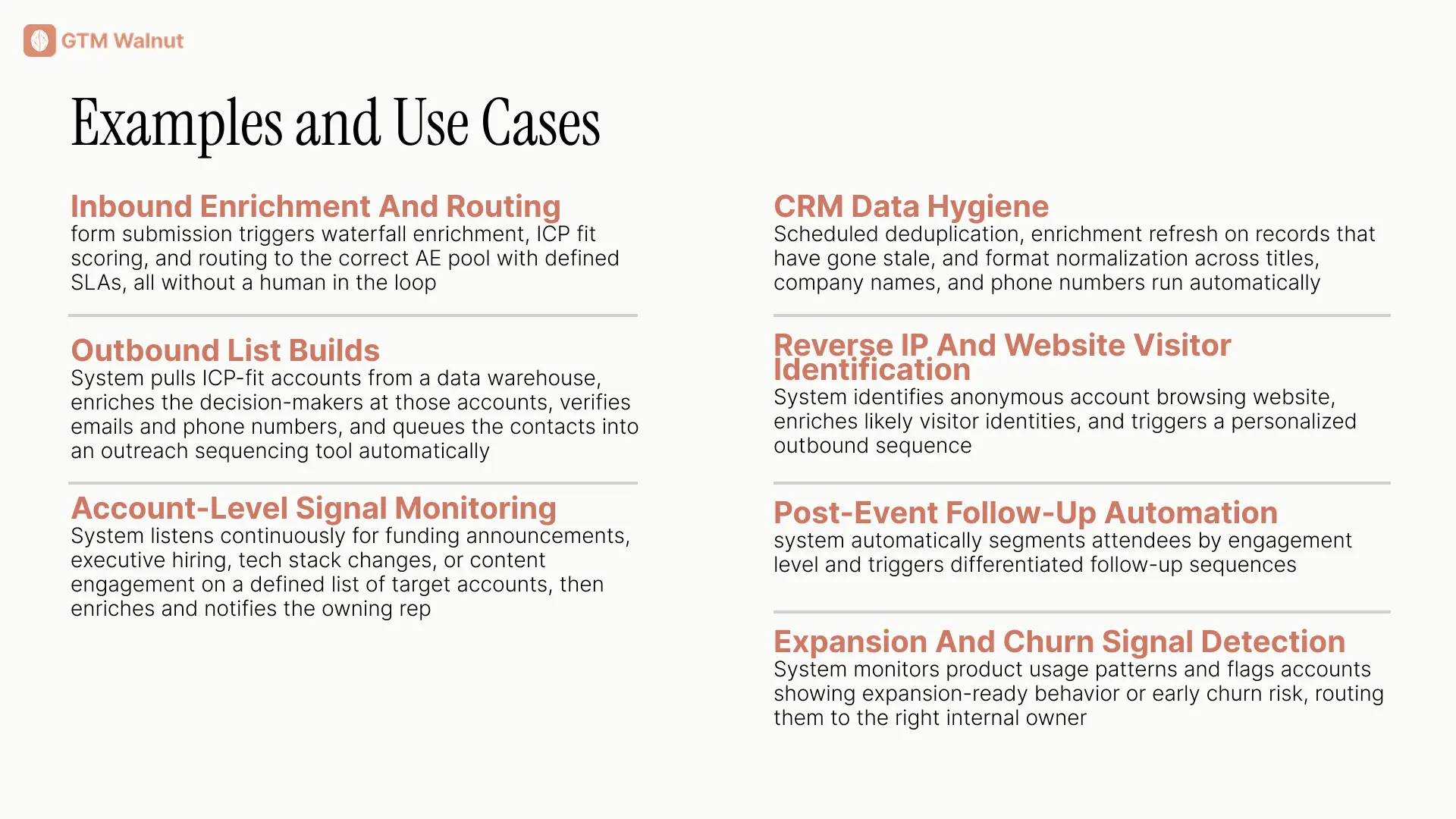
The seven most common playbooks that GTM engineering teams build first give a concrete sense of what this looks like in practice.
Inbound enrichment and routing
A form submission triggers waterfall enrichment, ICP fit scoring, and routing to the correct AE pool with defined SLAs, all without a human touching the lead until it is qualified and assigned.
Outbound list builds
On a weekly cadence, the system pulls ICP-fit accounts from a data warehouse, enriches the decision-makers at those accounts, verifies emails and phone numbers, and queues the contacts into an outreach sequencing tool automatically.
Account-level signal monitoring
The system listens continuously for funding announcements, executive hiring, tech stack changes, or content engagement on a defined list of target accounts, then enriches and notifies the owning rep the moment a relevant signal fires.
CRM data hygiene
Scheduled deduplication, enrichment refresh on records that have gone stale, and format normalization across titles, company names, and phone numbers run automatically rather than requiring a quarterly manual cleanup project.
Reverse IP and website visitor identification
When an anonymous visitor from a target account browses the website, the system identifies the account, enriches likely visitor identities, and triggers a personalized outbound sequence while the visit is still fresh in the prospect's mind.
Post-event follow-up automation
After a conference or webinar, the system automatically segments attendees by engagement level and triggers differentiated follow-up sequences rather than one generic post-event email blast.
Expansion and churn signal detection
For customer success and account management, the system monitors product usage patterns and flags accounts showing expansion-ready behavior or early churn risk, routing them to the right internal owner.
How GTM Engineers Measure Impact on Business Outcomes
The metrics that matter for a GTM engineering motion differ from what a traditional SDR team tracks, because the unit of measurement shifts from activity to system performance.
Signal-to-contact rate measures what percentage of captured signals produce a valid, reachable contact, with a healthy benchmark in 2026 sitting around 60% to 80%. Email open rate, with solid deliverability infrastructure in place, should land between 35% and 55%. Reply rate across all sent emails typically runs 3% to 8%, while positive reply rate, meaning replies that are genuinely interested rather than simply responsive, sits lower at 0.8% to 2.5%.
Meeting booked rate measures what percentage of positive replies convert into an actual booked meeting, with 50% to 70% being a healthy range. Cost per qualified meeting is one of the most important system-level metrics, typically running $150 to $400 depending on ICP complexity and channel mix. Domain health score, a composite measure of deliverability across sending domains, should stay above 85 out of 100 to protect the long-term viability of the email channel.
The honest test of whether a GTM engineering build is working is whether the number that matters to the business actually moved: meetings booked, hours saved, trial-to-paid conversion lifted, or cost of acquisition reduced. Good GTM engineering treats every workflow as a hypothesis. Ship a version, measure it against the relevant benchmark, and either scale it or kill it. This is also why signal decay rate deserves ongoing attention: how quickly a given signal type loses its predictive power should be monitored monthly, because what worked as a strong buying signal six months ago may have weakened as buyer behavior shifts.
How to Get Started: In-House vs. a GTM Engineering Partner
Most B2B companies face this decision once they have validated a GTM motion and want to scale it without linearly scaling headcount.
Hiring In-house
This makes sense once you have a playbook that is already working manually and you want a dedicated technical owner to scale it. The challenge is the hiring market: median GTM engineer salary in 2026 sits around $127,500 to $182,412 depending on the data source, with senior roles at top companies exceeding $250,000 in total compensation. The role also requires a genuinely rare combination of skills: SQL, API integration, workflow automation platform fluency, and a working understanding of revenue, funnel mechanics, and B2B sales motion. Finding someone who has all of that and ramps quickly takes time most early and growth-stage companies do not have.
Partnering with a GTM Engineering Team
This gets the infrastructure built faster, typically in 60 to 90 days versus the 4 to 6 months it can take to hire, ramp, and have an internal GTM engineer ship a fully working system. The right partner builds the system on your infrastructure rather than theirs, so you are not renting pipeline indefinitely. You end up owning the stack, the data, and the playbooks once the engagement matures.
GTM Walnut is built specifically around this model. Rather than hiring a single GTM engineer and hoping they can single-handedly architect, build, and maintain a full system, GTM Walnut deploys a complete 12-layer AI GTM system covering signal capture, waterfall enrichment via Clay, multi-sender LinkedIn outreach, email sequencing and deliverability infrastructure, CRM configuration, and pipeline attribution, all implemented on the client's own stack. The average time from kickoff to a fully live, operating system is 90 days.
Client results include $15M+ pipeline generated in eight months for a Series A company, 270+ SQLs in nine months for an HR Tech company, and 450+ MQLs in 14 months for a PropTech Series C. Founders Prashant Mantri and Soumya Surabhi bring direct operator experience from leading GTM functions at Y Combinator and Sequoia-backed startups, which means the systems are built by people who have personally been accountable for the pipeline number, not by engineers translating requirements secondhand.
For companies deciding between hiring a single GTM engineer internally or partnering with a team that has already built and refined these systems across dozens of engagements, GTM Walnut offers a faster, lower-risk path to a working signal-driven flywheel.
Conclusion
GTM engineering is the discipline of building automated, signal-driven systems that power modern B2B revenue teams, replacing the activity-intensive SDR model with infrastructure that compounds. It emerged because the GTM tech stack got too complex for manual operations, because intent and behavioral signals made timely action more valuable than raw volume, and because AI made building sophisticated systems accessible to a single technical operator rather than a full engineering team.
We covered what the discipline is, how it differs from RevOps and demand generation, the stack that powers it, what signal-driven flywheels actually look like in practice, concrete use cases, and how to measure whether a GTM engineering build is working. The decision most companies eventually face is whether to hire a dedicated GTM engineer internally or partner with a team that has already built and refined these systems across multiple engagements.
GTM Walnut builds the full GTM engineering stack for Seed to Series C B2B SaaS and services companies, implementing a complete 12-layer AI GTM system on your own infrastructure in an average of 90 days. With $320M+ in total pipeline built across 40+ client engagements, the model has been tested across a wide range of ICPs and stages.
Book a 30-minute system audit to see what a signal-driven GTM engineering build looks like for your company.
For the role-specific deep dive, see our GTM engineer guide.
For companies that run GTM engineering as a service, see our best GTM engineering companies guide.
For the foundational picture of B2B pipeline generation, see our B2B lead generation pillar.
GTM engineering is the discipline of designing, building, and operating the automated systems, data pipelines, and integrations that power a B2B go-to-market motion. It treats your revenue pipeline like a product: something built, shipped, measured, and continuously iterated on, rather than a series of manual campaigns run by an activity-driven team. The discipline sits at the intersection of sales operations, marketing automation, and data engineering, with AI as the layer that has made building these systems dramatically more accessible since 2023.
A GTM engineer is the person who builds, automates, and maintains the technical systems that power a company's go-to-market motion, covering lead capture, data enrichment, outreach sequencing, CRM workflows, and pipeline reporting. They write SQL, work with APIs, build automation workflows in tools like Clay and n8n, and understand revenue concepts like CAC, LTV, and funnel velocity well enough to know whether what they built actually moved the number that matters.
RevOps optimizes the engine that already exists: managing systems, processes, data governance, and reporting for the current GTM motion. GTM engineering builds new engines: designing and shipping new systems like enrichment pipelines, signal-triggered outbound sequences, and routing workflows. A simple test is whether the question is about adjusting an existing process (RevOps) or building something new that did not exist before (GTM engineering). In practice, the two functions overlap significantly at smaller companies and separate into distinct roles as a company scales.
GTM engineers track system-level metrics rather than pure activity metrics: signal-to-contact rate (60-80% is healthy), email open rate (35-55% with solid deliverability), reply rate (3-8%), positive reply rate (0.8-2.5%), meeting booked rate (50-70% of positive replies), cost per qualified meeting ($150-400), and domain health score (above 85/100). The ultimate test is whether the metric that matters to the business, such as pipeline generated, meetings booked, or cost of acquisition, actually moved as a result of the system shipped.
The core 2026 GTM engineering stack typically includes Clay for waterfall enrichment and AI-powered account research, n8n or Zapier for workflow orchestration, HubSpot or Salesforce as the CRM system of record, Smartlead or Instantly for email sequencing and deliverability, HeyReach for multi-sender LinkedIn outreach, and Claude or GPT-based AI agents for personalized outreach copy at scale. The specific tools matter less than the ability to connect them into a coherent system rather than a set of disconnected point solutions.
GTM Walnut is an AI-native GTM engineering partner that builds the full B2B marketing and pipeline infrastructure for Seed to Series C companies. Unlike traditional B2B marketing agencies that run campaigns on their own systems, GTM Walnut implements the entire stack on your infrastructure: content and AI SEO for inbound pipeline, outbound automation for signal-triggered outreach, CRM RevOps for pipeline attribution, and intent signal capture to surface in-market accounts before they fill out a form.
Clients have generated $15M+ pipeline in eight months, 450+ MQLs in 14 months, and 270+ SQLs in nine months across different verticals. The system is yours to own and operate from day one, which means you build a compounding pipeline asset rather than a recurring agency dependency. Book a 30-minute system audit to see what the build looks like for your ICP and stage.
Fixed monthly retainer, starting at $2,500/month and scaling with scope. Most engagements land between $2,500 and $6,000/month depending on email volume, channel mix, geos, and whether CRM/RevOps work is included.
We don't do pure outcome-based pricing because infrastructure, list building, and messaging cost the same regardless of meetings booked, and outcome-only models tend to push agencies toward shortcuts that wreck your domain. We do stand behind the outcomes we forecast in the proposal; it's just not the billing mechanism.
Soumya is a B2B SaaS GTM and demand-generation leader who has built multi-million-dollar pipelines for early-stage and growth companies. She led GTM programs at Y Combinator and now runs GTM Walnut, an AI-native revenue infrastructure firm working with 40+ B2B SaaS and services teams.