12 Best AI SDR Tools and Software in 2026 (Compared)
Compare the 12 best AI SDR tools and software for 2026 with real pricing, from $49/mo to $60K/yr, ranked by use case, data, and deliverability.


The AI SDR tool market has exploded to dozens of platforms in under two years, and the gap between the marketing claims and production reality is wide. Choosing the wrong AI SDR tool does not just waste budget. It burns through your addressable market with mediocre outreach and damages your domain reputation in ways that take months to repair.
Here is the filter that cuts through the noise: an AI agent is only as effective as the platform surrounding it. Several of the most-hyped AI SDR tools score near zero on deliverability infrastructure, which means they write great emails that land in spam. When evaluating any tool on this list, the data layer and the deliverability layer matter more than the AI writing itself.
We build AI-native pipeline systems, so we track this tooling landscape closely. Below we cover what AI SDR software is, how we evaluated these tools, the 12 best AI SDR tools for 2026 with real pricing, how to choose, and the honest question of whether a tool or a full system is the right call for your team.
For the foundational context on what these tools do and where they succeed or fail, see our AI SDR guide. For the discipline behind building outbound systems, see our GTM engineering guide.
What Is AI SDR Software?
AI SDR software automates the work of a sales development rep: finding prospects, researching accounts, generating personalized outreach, sending across channels, and in some cases handling replies and booking meetings. It uses large language models, data enrichment, and workflow automation to run the top-of-funnel motion at machine scale.
The category splits into two distinct jobs that are easy to confuse. Sending agents run the outreach itself: prospecting, writing, and sequencing across email and LinkedIn. Tools like 11x, Artisan, AiSDR, Amplemarket, and Reply.io's Jason AI live here. Answering agents handle the inbound prospect who clicks or replies, converting website traffic in real time. Qualified's Piper and Agentforce SDR live here. Most tools do one side well, not both. Knowing which job you actually need to solve is the first step in choosing a tool.
There is a further split worth understanding. Some AI SDR tools are all-in-one platforms that bundle data, sending, and AI. Others are AI layers that sit on top of your existing stack. And a growing number of teams skip point tools entirely in favor of an owned system built in-house or with a GTM engineering partner, which trades setup effort for full control and lower long-run cost.
How We Evaluated These AI SDR Tools
We ranked these tools against five criteria that actually predict pipeline results rather than demo appeal.
.jpg)
Deliverability Infrastructure
This is the criterion most buyers overlook and the one that most determines success. Warm-up, sender rotation, domain health monitoring, and inbox placement testing decide whether your outreach lands in the inbox or the spam folder. Several popular tools score near zero here, which is disqualifying for serious cold outbound.
Data Quality and Coverage
An AI SDR is only as good as the contacts and signals feeding it. We weighted built-in data coverage, enrichment quality, and whether data is bundled or charged separately, since data add-ons are where advertised pricing quietly balloons.
Personalization Depth
We evaluated whether the tool generates genuinely contextual outreach from real research, or produces template-like messaging at volume that prospects recognize as automated. Depth matters more than raw send capacity.
Pricing Transparency
We favored tools that publish real pricing over those requiring a sales call for every number, and we flagged the hidden costs (data, channel add-ons, seat minimums) that make the advertised figure rarely match the invoice.
Fit by Use Case
There is no single best AI SDR tool. We matched each to its genuine strength: outbound volume, inbound conversion, human-in-the-loop control, or budget-conscious starting point.
The 12 Best AI SDR Tools in 2026
1. GTM Walnut
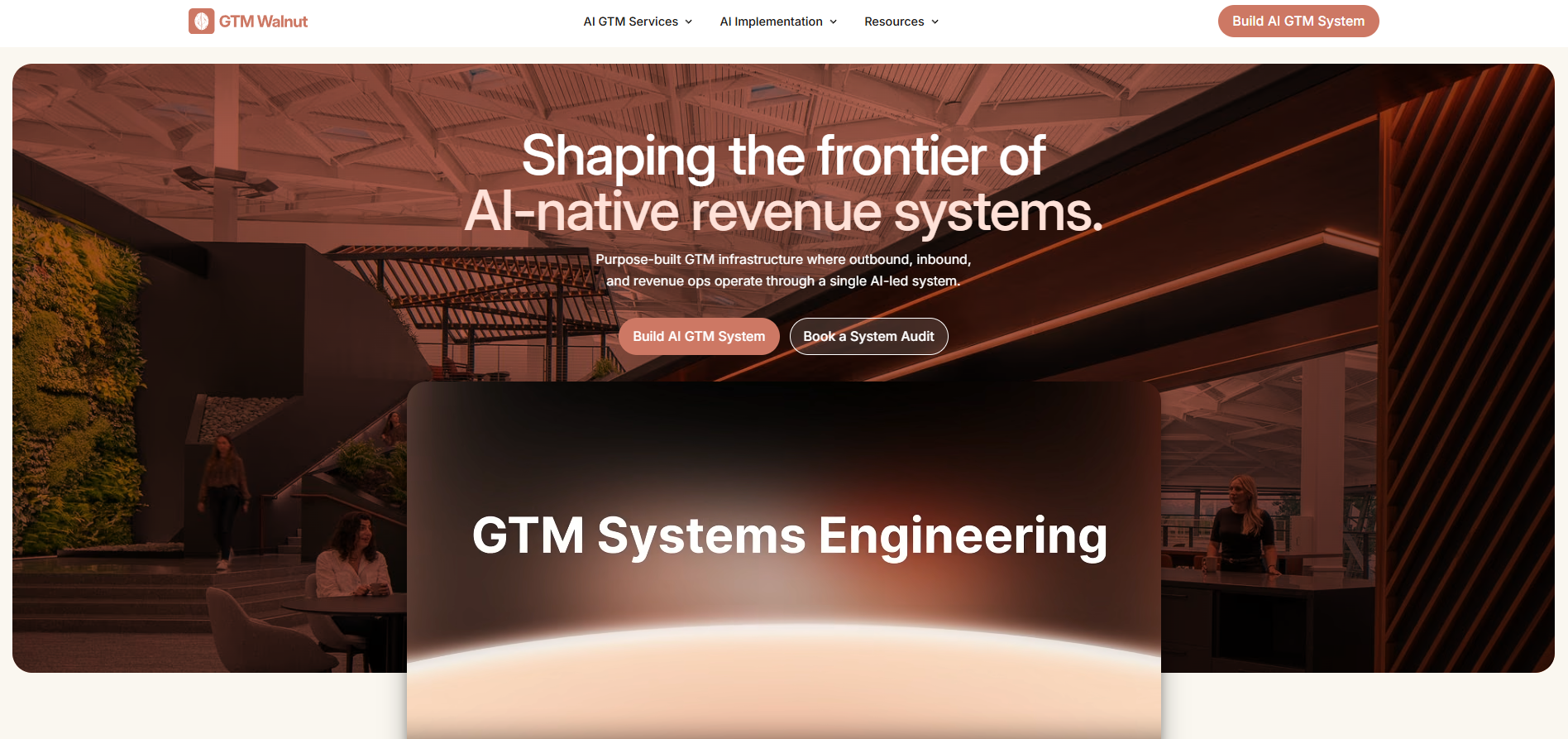
GTM Walnut is the pick for teams that want the output of an AI SDR without the core weakness of point tools: renting infrastructure that leaves when you stop paying, and inheriting a vendor's deliverability limits. Rather than a single AI SDR product, GTM Walnut builds a complete owned AI SDR system on your own stack for Seed to Series C B2B SaaS and services companies.
That system combines the layers that standalone tools handle unevenly: signal capture, waterfall enrichment via Clay, AI-personalized outreach with human oversight, multi-sender email via Instantly, LinkedIn via HeyReach, and, critically, the full deliverability infrastructure (dedicated domains, warm-up, DMARC configuration, inbox rotation) that so many popular AI SDR tools score near zero on. Because the system is engineered rather than bought off the shelf, it runs the hybrid model the 2026 evidence favors: AI on the volume, humans on the judgment.
Client results include $15M+ pipeline in eight months for a Series A company and 270+ SQLs in nine months for an HR Tech company, with an average of 90 days from kickoff to a live system. For teams that have sat through 11x and Artisan demos and concluded they want to own the machine rather than rent it, GTM Walnut is the alternative. Book a system audit to see what an owned AI SDR system looks like for your stage.
Best for: Owned AI SDR system, Seed to Series C
Type: Full engineered system (delivered as a service)
2. 11x
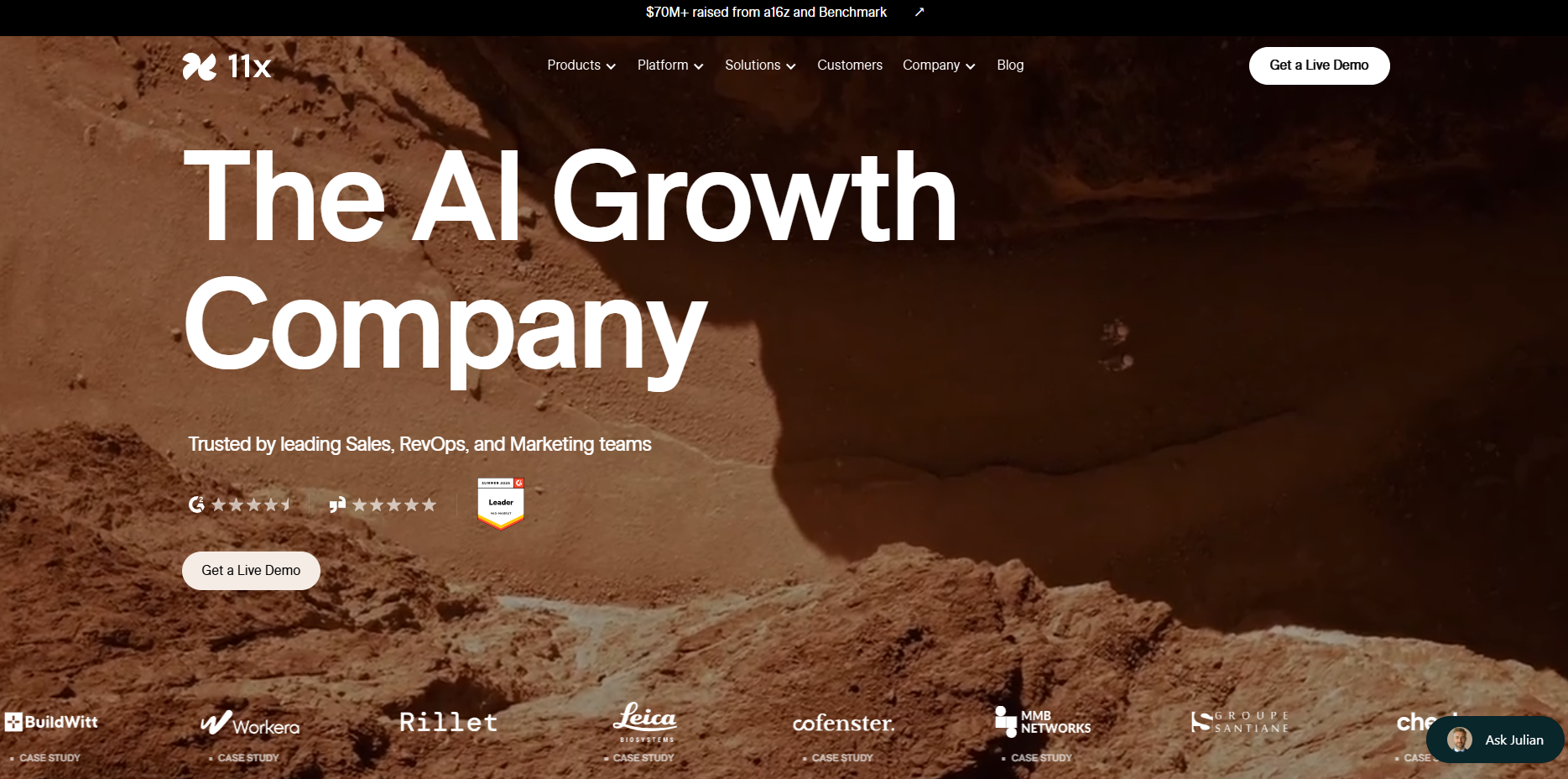
11x pioneered the autonomous AI SDR category with its agents Alice for outbound and Mike for inbound voice, and it remains one of the most capable and recognized platforms for fully autonomous outbound. It is built for teams that want the entire top-of-funnel handled with minimal human involvement.
The honest caveats matter here. 11x's published Growth plan runs around $3,750 per month billed annually, roughly $60,000 per year, and independent testing scores it near zero on deliverability infrastructure (no warm-up, no inbox placement testing, no domain health monitoring). That combination of high price, full autonomy, and thin deliverability means 11x works best for enterprise teams that layer their own deliverability infrastructure underneath it, not as a complete standalone solution. The category's shift away from full autonomy toward hybrid also applies here.
Best for: Fully autonomous outbound at enterprise scale
Type: Sending agent
3. Artisan (Ava)
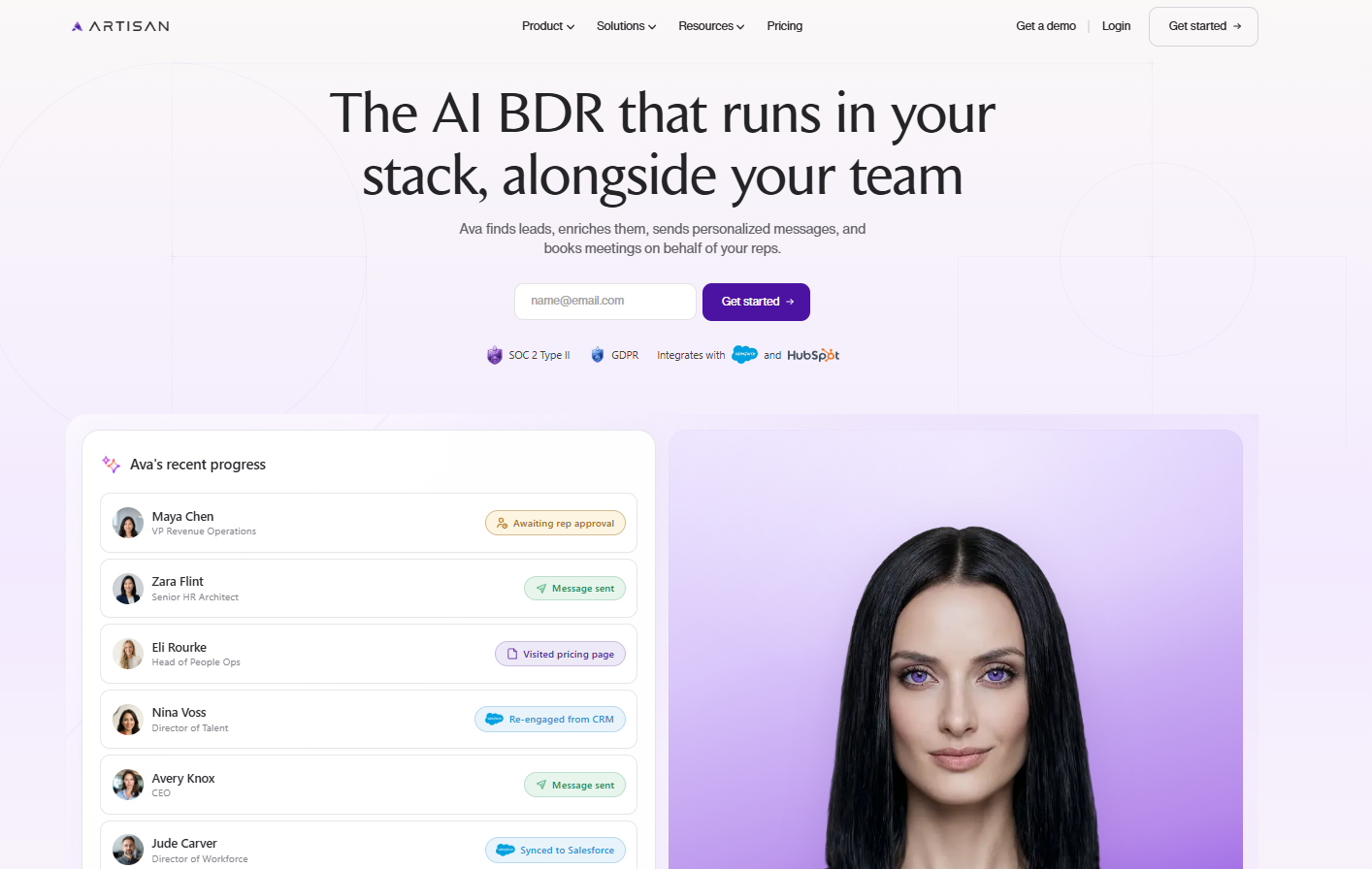
Artisan's Ava is one of the strongest all-in-one AI SDR tools, covering both outbound (Ava) and inbound website visitors (Ava Inbound), which is rare since most tools do one side well. It combines a 300M+ contact database with personalized email and LinkedIn outreach in a single agent, priced at roughly $2,000 to $5,000 per month.
Artisan is a genuine option for mid-market teams that want one vendor across prospecting and engagement. The same deliverability caveat applies: independent scoring puts Artisan near zero on the deliverability stack, so serious senders should plan to reinforce that layer. Artisan customers report pipeline at roughly one-fifth the cost of a human BDR, which captures the core economic appeal of the category.
Best for: All-in-one outbound plus inbound
Type: Sending agent
4. Amplemarket
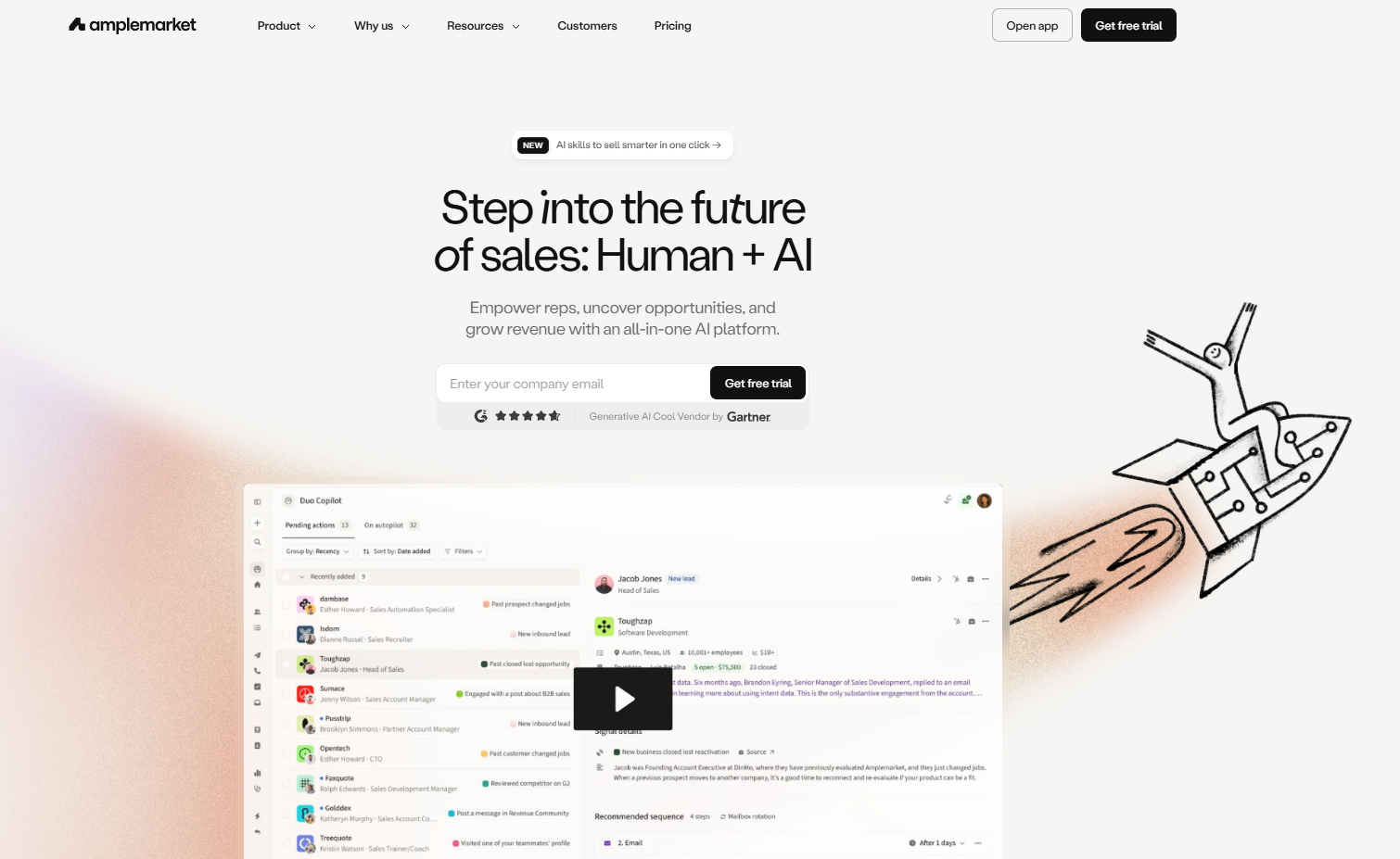
Amplemarket is the strongest full-stack option, bundling a contact database, a multichannel engagement platform, and Duo, its AI agent, into one system. That native pairing of data and execution puts it closer to a complete solution than most sequencer-plus-agent competitors, and it is one of the few tools that takes deliverability seriously as a built-in layer rather than an afterthought.
Amplemarket targets mid-market and enterprise buyers with signal-based selling and multichannel execution. Entry pricing sits around $600 per month but is not fully published, and a realistic loaded stack at scale can run significantly higher once seats and channels compound. For teams that want data, warm-up, sequencing, and AI from a single vendor, Amplemarket is a leading choice.
Best for: Full-stack data plus AI plus deliverability
Type: All-in-one
5. AiSDR
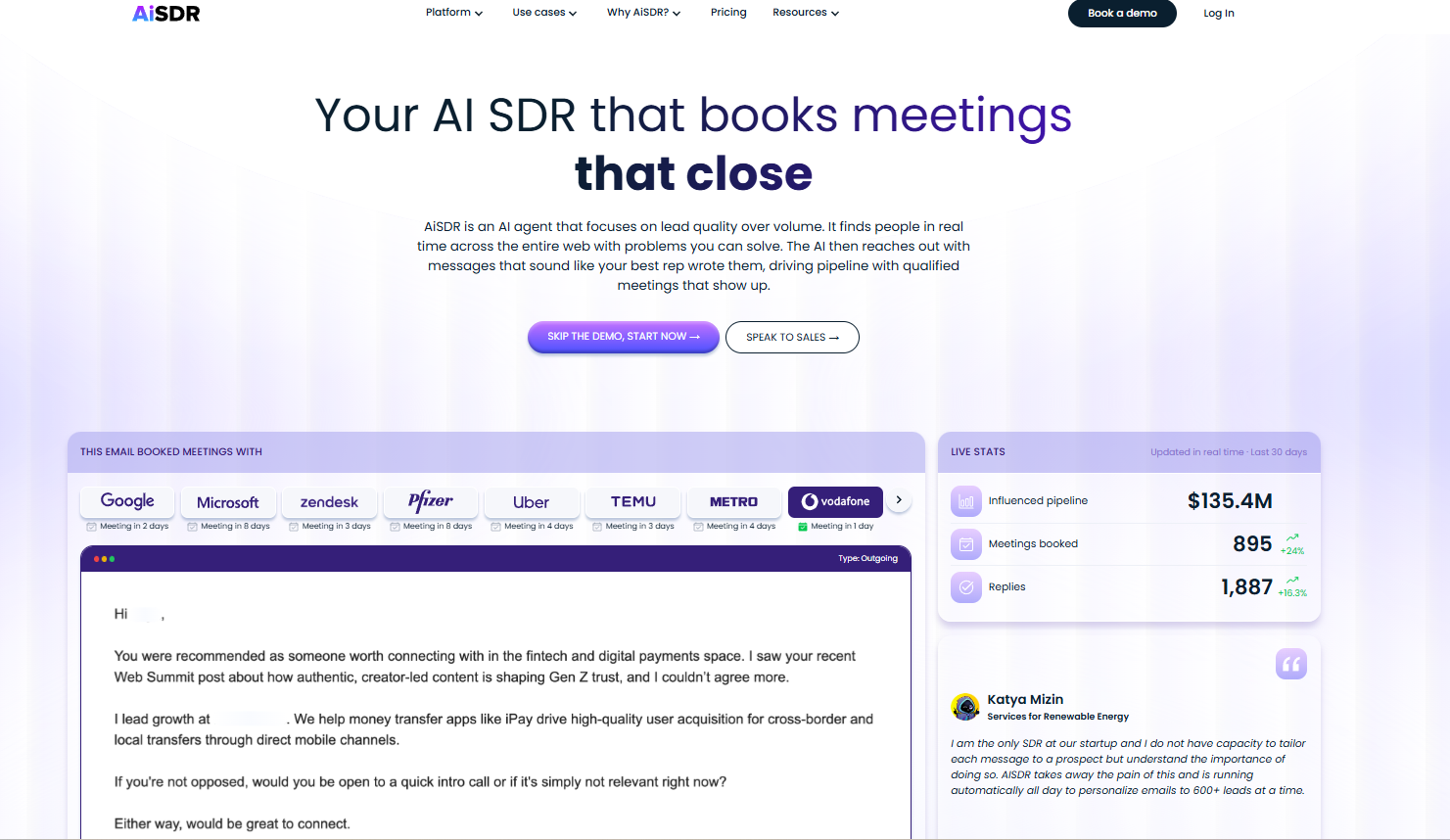
AiSDR is the go-to for teams that want transparent, published pricing and a working AI SDR quickly. Its Solo tier starts at $250 per month, one of the lowest credible entry points in the category, with rates published openly rather than gated behind a sales call.
AiSDR automates execution, handling email and LinkedIn outreach with AI personalization, more than it owns the entire sales development job end to end. That makes it a strong fit for startups and SMBs that want a functioning AI SDR this week at a known price. Teams needing deeper governance, CRM depth, or full workflow ownership will eventually outgrow it, but as an accessible starting point it is hard to beat on transparency.
Best for: Transparent mid-market pricing
Type: Sending agent
6. Reply.io (Jason AI)
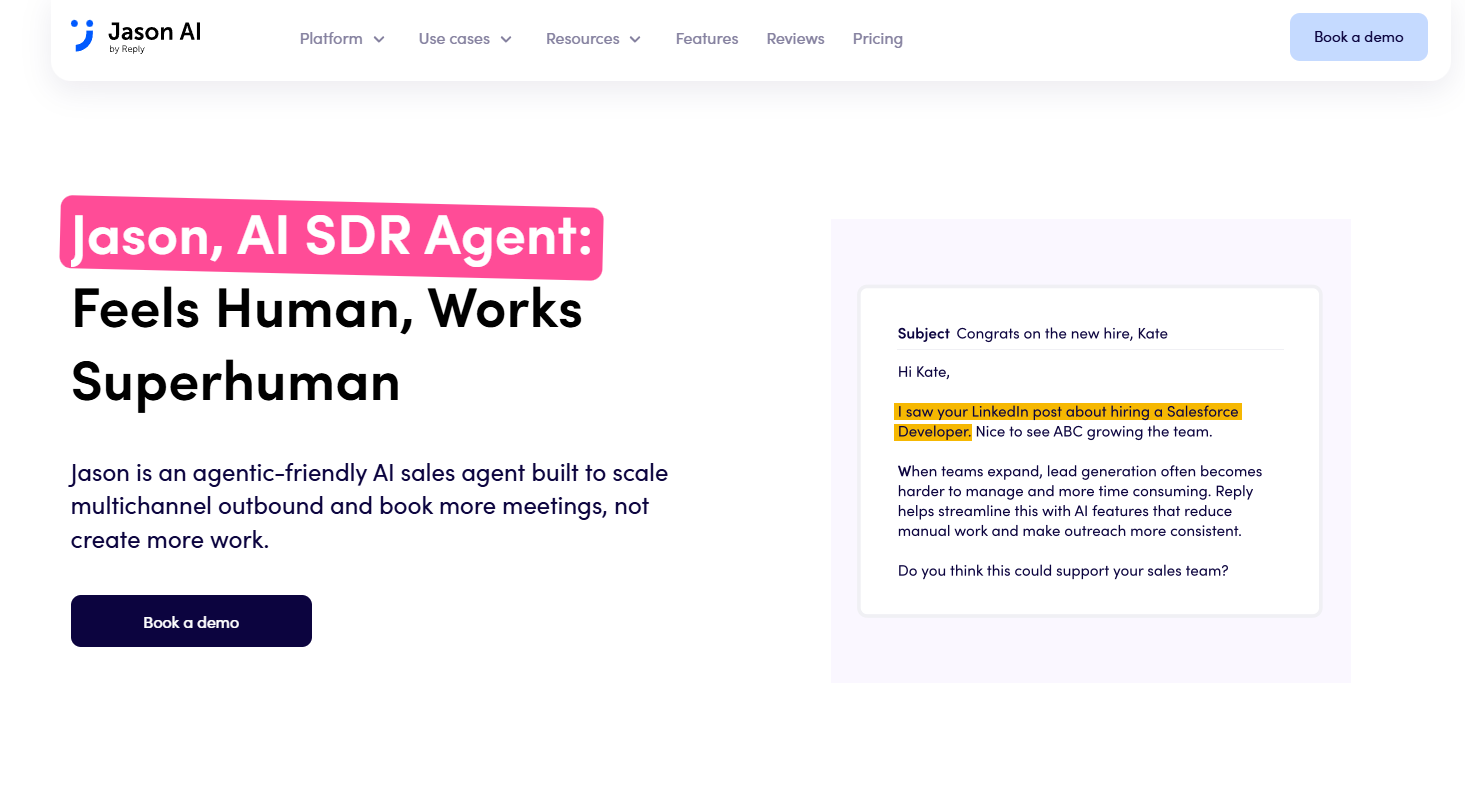
Reply.io's Jason AI is the most granularly priced tool in the category, which makes it a strong fit for teams that want to pay precisely for what they use. AI SDR Starter runs from $500 per month annually for 1,000 active contacts, scaling to $1,500 for 5,000 and $3,000 for 10,000, with the core Reply.io sequencing platform available separately from $49 per user per month.
Jason AI focuses on AI-enhanced multichannel sequencing across email, LinkedIn, calls, and SMS with strong reply management. The granular pricing is a double-edged sword: channel add-ons compound, so the advertised figure is rarely the final invoice. For teams that want affordable, flexible, multichannel AI sequencing and are willing to model the true cost, Reply.io is a capable option.
Best for: AI-enhanced multichannel sequencing
Type: Sending agent
7. Regie.ai
Regie.ai is the standout for teams that want rep-assist rather than rep-replacement, which aligns with the human-in-the-loop model that has proven most effective in 2026. Its AI writing quality is among the best in the category, and unlike most competitors it bundles data (1,000 accounts and 4,000 contacts monthly on its Force Multiplier tier) rather than charging for it separately.
Pricing starts around $18,000 per year, placing it in the enterprise tier. Regie's deliverability scoring is thin like most pure AI-writing tools, so the same infrastructure caveat applies. For sales teams that want AI to augment human reps with high-quality drafts and research rather than run fully autonomously, Regie.ai is purpose-built for that philosophy.
Best for: Rep-assist, human-in-the-loop
Type: Sending agent
8. Qualified (Piper)
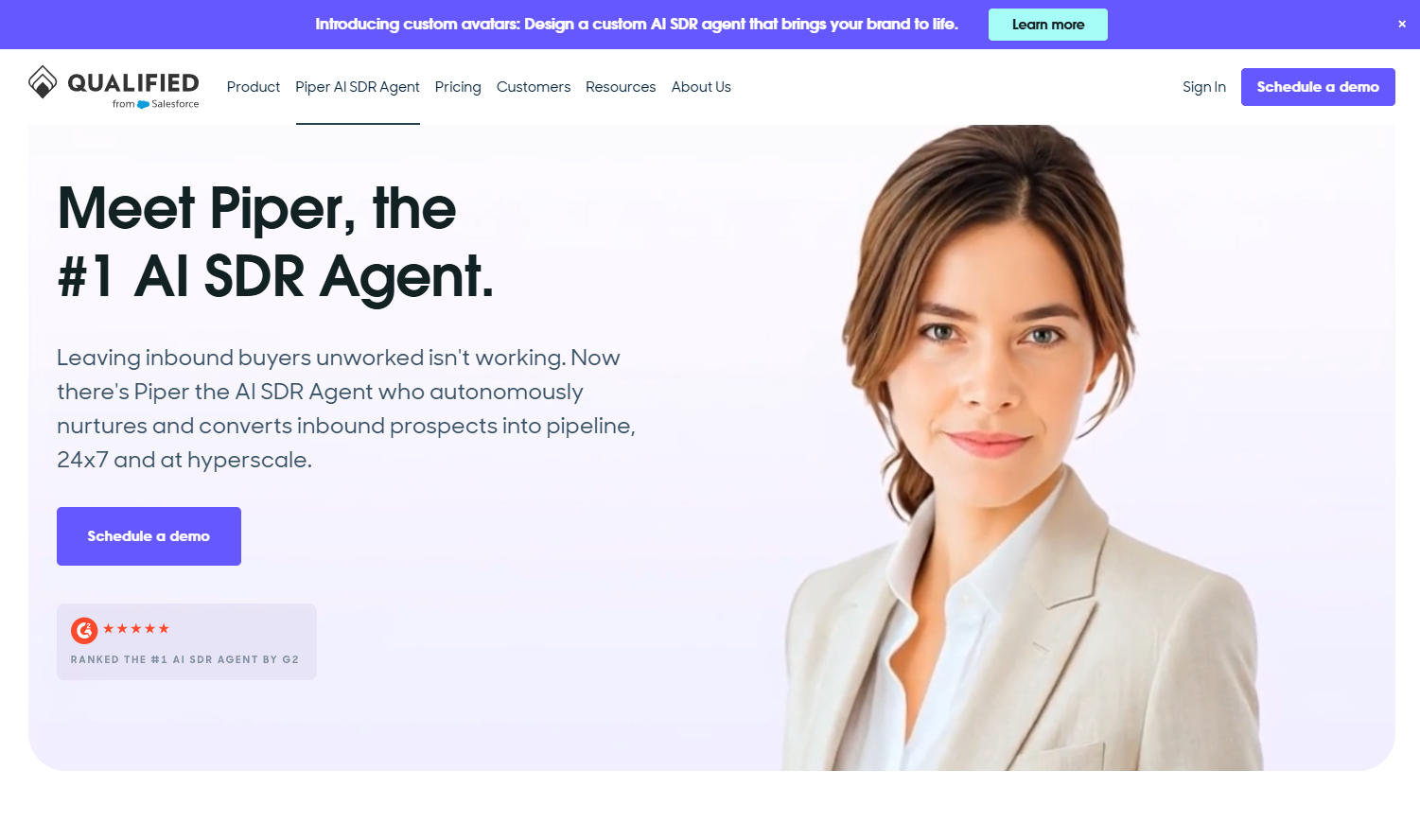
Qualified's Piper is the leading inbound AI SDR, built to convert website visitors into pipeline in real time rather than run cold outbound. Piper engages visitors, qualifies them against ICP criteria, routes high-fit visitors to reps or books meetings directly, and handles lower-fit visitors with automated nurture. Salesforce's acquisition of Qualified closed in April 2026, deepening its native Salesforce integration.
Qualified is Salesforce-native and priced for enterprise, running roughly $40,000 to over $100,000 per year. It is the right tool for revenue teams that have already solved outbound prospecting and want to capture more of the inbound demand arriving at their website. It solves a fundamentally different problem than the outbound sending agents on this list.
Best for: Inbound website conversion
Type: Answering agent
9. Apollo.io
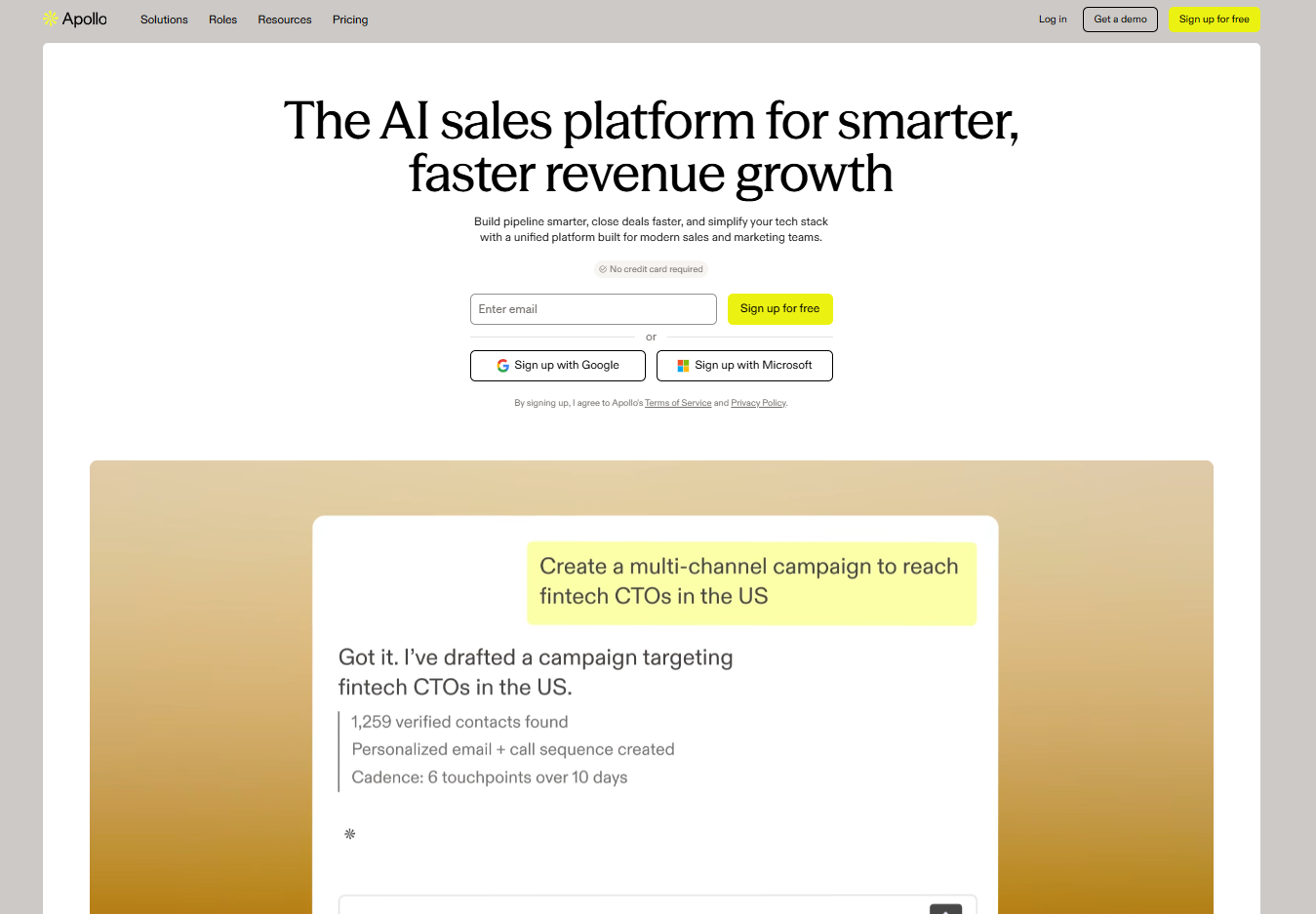
Apollo.io is the best budget-conscious entry point, combining a 275M+ contact database with built-in sequencing and AI features from $49 per user per month, including a genuinely useful free tier. For early-stage teams that need contact data and outreach tooling in one affordable platform, Apollo covers the basics well.
Its AI SDR capabilities are lighter than the specialized tools on this list, and data quality for enterprise targets trails premium databases. But for SMB and mid-market teams in the US that want to start outbound without a large commitment, Apollo's combination of price, data, and a free tier makes it the most accessible on-ramp in the category.
Best for: Budget-conscious teams
Type: All-in-one
10. Salesforge (Agent Frank)
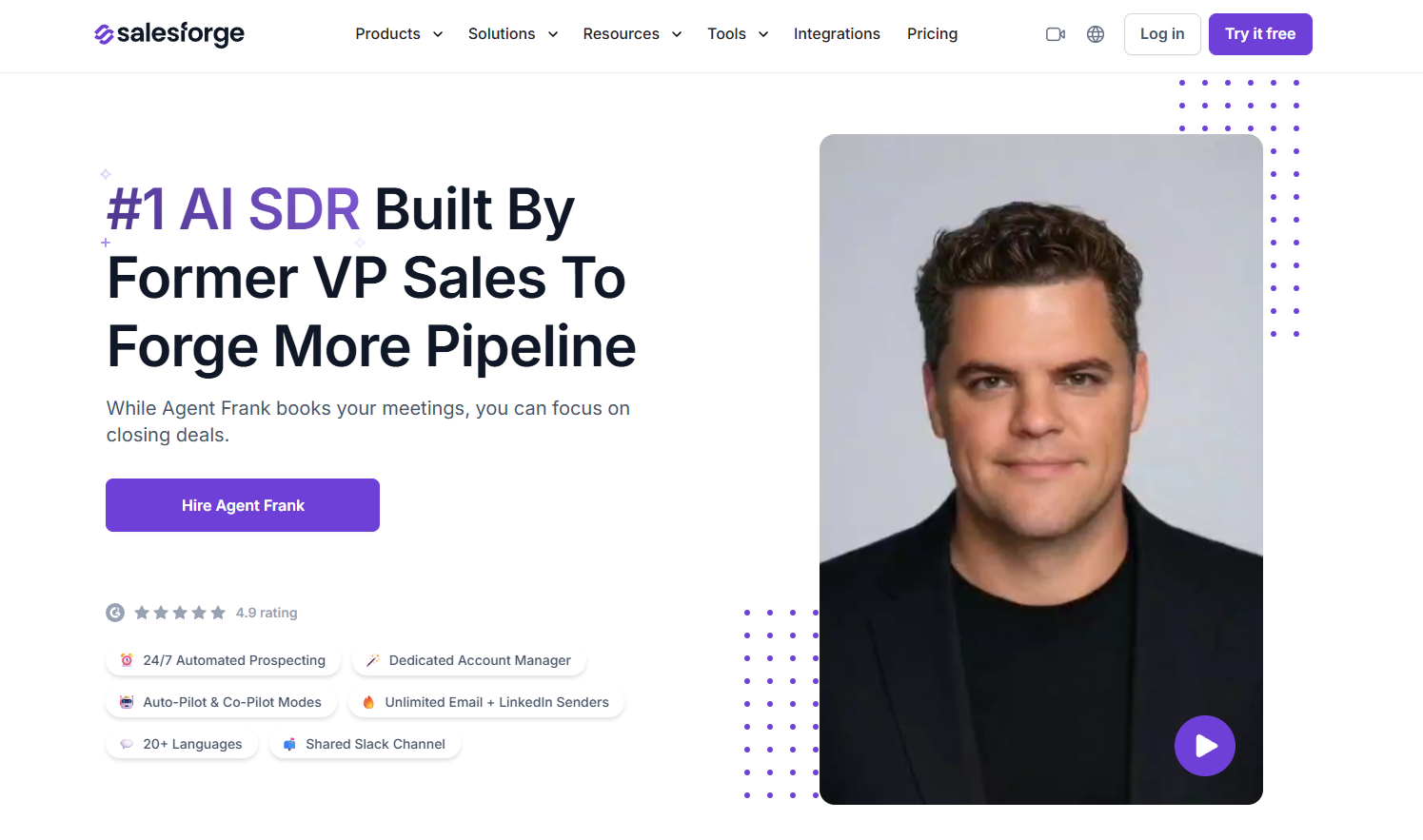
Salesforge, through its Agent Frank AI SDR, is the specialist for deliverability-first outbound, which addresses the exact weakness that undermines most of the flashier AI SDR tools. It uses multi-inbox strategies and automated warm-up to protect domain reputation while scaling send volume, making it a strong fit for teams whose primary concern is landing in the inbox.
For companies that have been burned by AI SDR tools writing great emails that go straight to spam, Salesforge's infrastructure focus is the differentiator. It handles the sending and deliverability layer with more rigor than tools that treat deliverability as an afterthought, at an accessible entry price.
Best for: Deliverability-first outbound
Type: Sending agent
11. Warmly
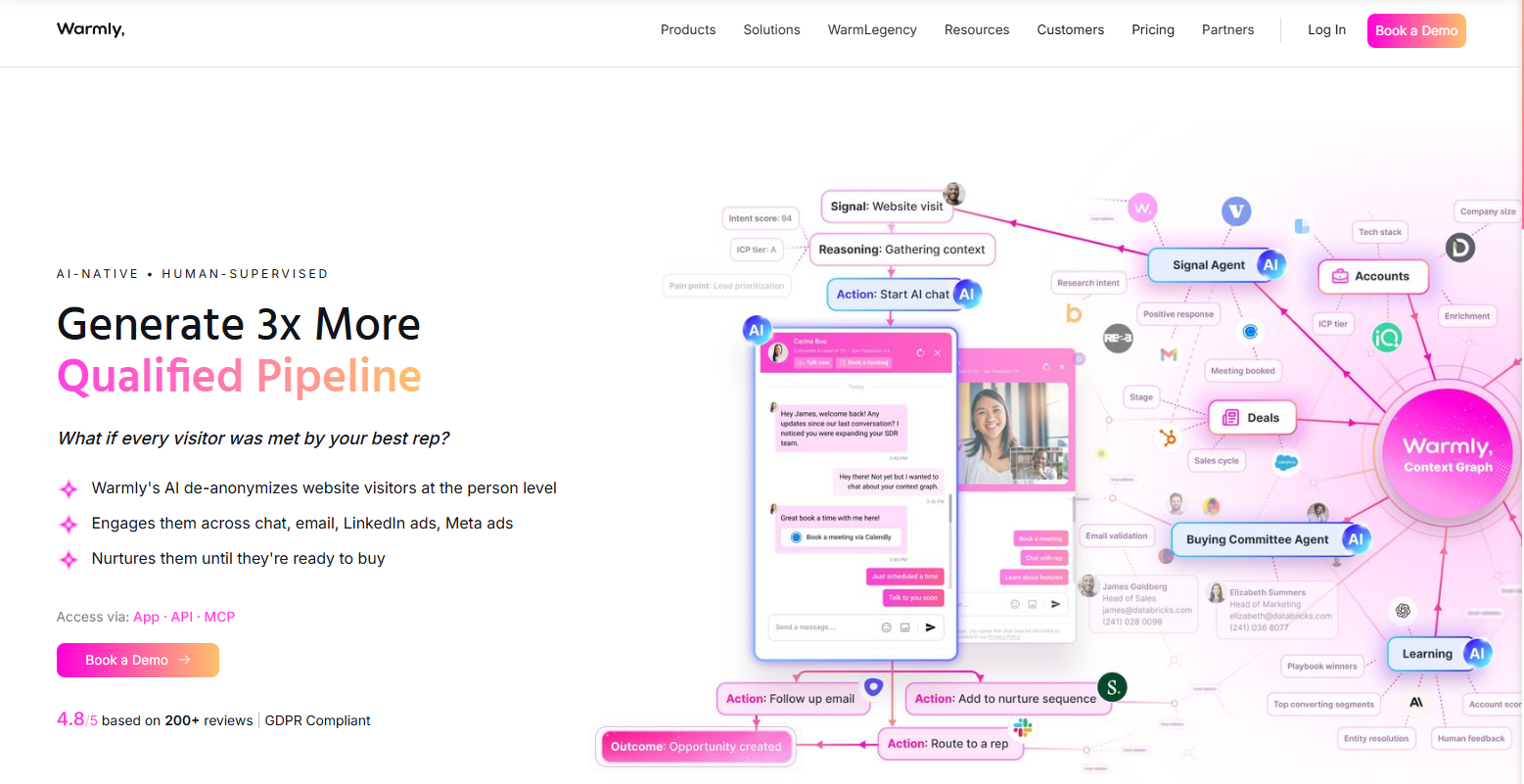
Warmly is a website intelligence and visitor identification tool that adds an inbound signal layer to an outbound motion. It identifies anonymous website visitors, surfaces buying intent from on-site behavior, and triggers outreach to warm accounts rather than purely cold ones, priced in the $500 to $3,000 per month range.
Warmly is best understood as a complement to a sending agent rather than a full AI SDR on its own, since it lacks the daily playbook and dialer of the fuller platforms. For teams that want to capture warm website traffic and route it into outreach, Warmly's visitor intelligence fills a specific and valuable gap.
Best for: Website visitor identification and warm outreach
Type: Answering agent / signal layer
12. Clay
Clay is not an AI SDR in the send-the-outreach sense. It is the enrichment and AI research layer that powers the best AI SDR systems, which is exactly why it belongs on this list. Clay runs waterfall enrichment across 50+ data providers to maximize contact match rates, and its Claygent AI agent researches accounts at scale, pulling the specific signals that make outreach relevant.
Pricing starts around $149 per month and scales with usage. Most sophisticated AI SDR systems, including the ones built by GTM engineering partners, use Clay as their data foundation and pair it with a separate sending tool. For teams building their own outbound stack rather than buying an all-in-one, Clay is the near-universal starting point for the data layer.
Best for: Enrichment and AI research layer
Type: Data/AI layer
How to Choose an AI SDR Tool
The right choice comes down to matching a tool to your actual motion and being honest about the hidden costs.
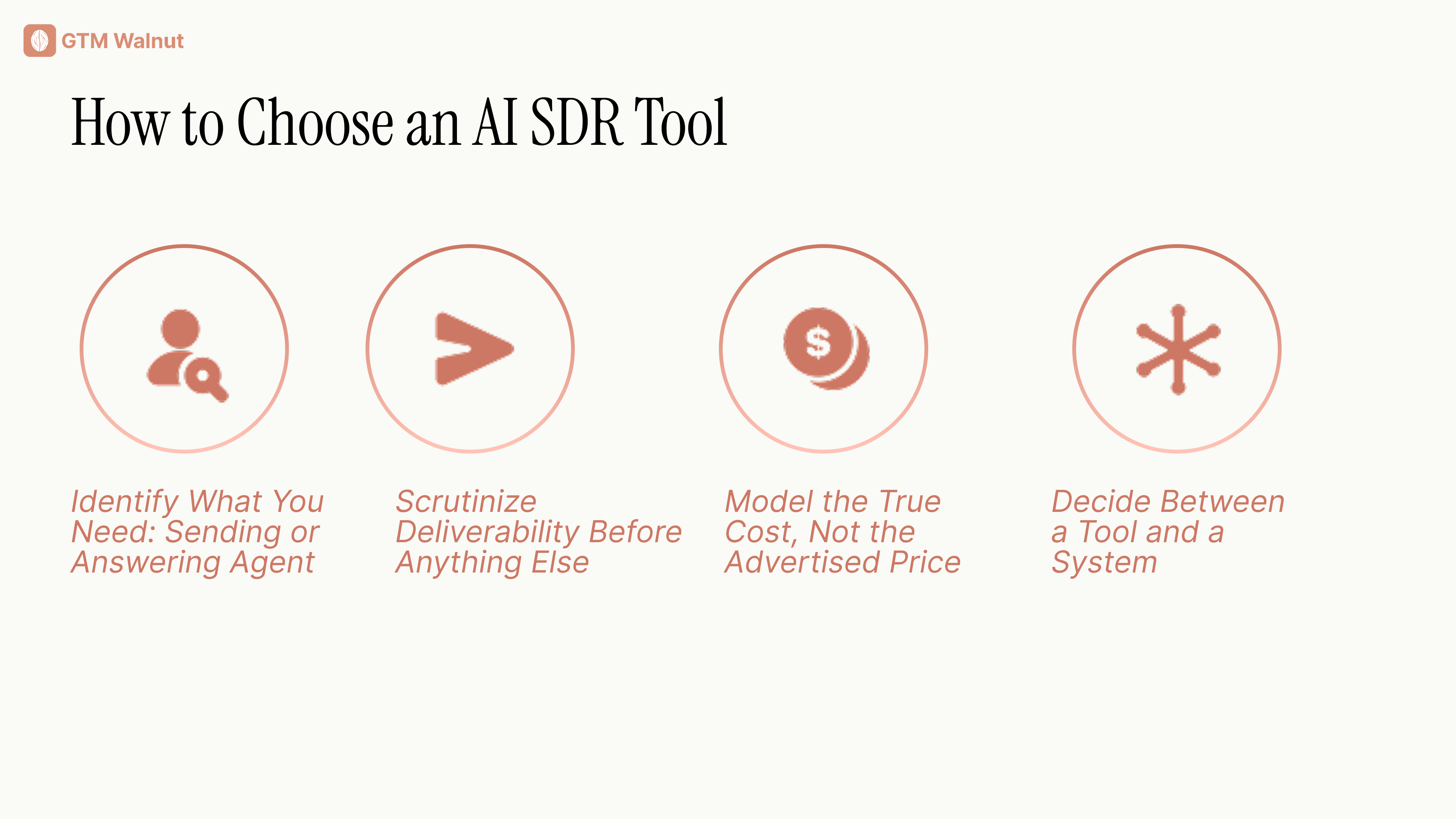
Identify Whether You Need a Sending or Answering Agent
If your problem is generating cold pipeline, you need a sending agent like Artisan, AiSDR, or Salesforge. If your problem is converting inbound website traffic, you need an answering agent like Qualified or Warmly. Buying the wrong type is the most common expensive mistake, since these solve fundamentally different problems.
Scrutinize Deliverability Before Anything Else
Because several popular AI SDR tools score near zero on deliverability infrastructure, ask specifically about warm-up, sender rotation, domain health monitoring, and inbox placement testing. A tool that writes brilliant emails with no deliverability layer is an expensive way to damage your domain reputation. If the tool is thin here, budget for a separate deliverability solution underneath it.
Model the True Cost, Not the Advertised Price
The advertised figure is rarely the invoice. Data is often charged separately or capped tightly, channel add-ons for LinkedIn, calls, and SMS compound, and seat minimums inflate the total. A realistic loaded stack can run several times the entry price. Ask for an all-in annual number at your actual seat count and volume before committing.
Decide Between a Tool and a System
A point tool is fast to start but leaves you renting infrastructure with the vendor's limits baked in. An owned system, built in-house or with a GTM engineering partner, takes more setup but gives you full control of data, deliverability, and workflow, and lower cost at scale. Teams serious about outbound as a long-term channel increasingly choose the owned-system route.
AI SDR Tools vs. a Full System
Every tool on this list solves part of the AI SDR problem, but the 2026 lesson is that AI SDR performance is a systems problem, not a single-tool problem. The AI writing is rarely the bottleneck. The data feeding it, the signals triggering it, and the deliverability infrastructure carrying it determine whether the whole thing produces pipeline or spam.
That is why the highest-performing setups treat the AI as one layer in an engineered system rather than a product that does everything. A tool like 11x or Artisan gives you the agent but leaves you to solve deliverability and data. A tool like Clay gives you the data layer but not the sending. Stitching these together well is real work, and doing it badly is how teams burn their addressable market with mediocre outreach.
For teams that want the outcome without assembling and maintaining the stack themselves, GTM Walnut builds the complete owned system, data, signals, AI-personalized outreach with human oversight, and full deliverability infrastructure, on the client's own stack in an average of 90 days, with $320M+ in total pipeline generated across 40+ engagements. It is the AI SDR model built the way the evidence says it should be: engineered as a system, run as a hybrid.
Conclusion
The 12 AI SDR tools here span the full category: fully autonomous outbound (11x), all-in-one agents (Artisan, Amplemarket), transparent mid-market options (AiSDR, Reply.io), rep-assist (Regie.ai), inbound conversion (Qualified, Warmly), budget on-ramps (Apollo), deliverability specialists (Salesforge), and the data layer that powers them all (Clay). The right pick depends on your motion, your budget, and how much of the stack you want to own.
The deeper lesson from 2026 is that AI SDR success is a systems problem. The AI writing is rarely the bottleneck; data, signals, and deliverability are. Teams that treat the AI as one layer in an engineered system consistently outperform those chasing the flashiest autonomous agent.
For Seed to Series C B2B SaaS and services companies that want the full AI SDR system built and owned rather than rented from a point tool, GTM Walnut assembles the complete stack, data, signals, AI-personalized outreach with human oversight, and deliverability infrastructure, on your own stack in an average of 90 days.
Book a 30-minute system audit to see what an owned AI SDR system looks like for your team.
For done-for-you partners, see our best GTM engineering companies guide.
There is no single best AI SDR tool; the right choice depends on your motion. For fully autonomous outbound, 11x leads. For all-in-one outbound plus inbound, Artisan. For transparent mid-market pricing, AiSDR. For inbound website conversion, Qualified's Piper. For rep-assist and human-in-the-loop, Regie.ai. For the cheapest credible starting point, Apollo.io. For deliverability-first outbound, Salesforge. And for teams that want to own the entire system rather than rent a tool, a GTM engineering partner builds the full stack. Match the tool to whether you need outbound volume, inbound conversion, or human-in-the-loop control.
AI SDR tool pricing in 2026 spans two orders of magnitude, from about $49 per user per month (Apollo) and $250 per month (AiSDR Solo) at the low end to roughly $60,000 per year (11x) and $40,000 to $100,000+ per year (Qualified) at the enterprise end. Mid-market tools like Artisan run $2,000 to $5,000 per month. The advertised price is rarely the final cost: data is often billed separately, channel add-ons compound, and seat minimums apply. Model the all-in annual cost at your real volume before committing.
No. The 2026 evidence shows fully autonomous AI SDR tools deployed as human replacements have underperformed, with many companies reverting to hybrid models. The effective model is human-in-the-loop: AI handles volume (prospecting, research, first drafts, sequencing) while humans handle judgment (qualifying replies, managing relationships, closing). Tools like Regie.ai are explicitly built for this augmentation approach. Teams using AI to augment rather than replace human SDRs report meaningfully more pipeline than either extreme.
Deliverability infrastructure, which is also the feature most buyers overlook. Several popular AI SDR tools score near zero on warm-up, sender rotation, domain health monitoring, and inbox placement testing, which means they produce well-written emails that land in spam. Since an AI agent is only as effective as the platform around it, deliverability and data quality matter more than the AI writing itself. Always evaluate the infrastructure layer before being impressed by the demo.
Yes, and a growing number of teams do, either in-house or with a GTM engineering partner. Building your own system means combining a data layer (typically Clay), a sending and deliverability layer (Instantly, Smartlead, HeyReach), an AI layer for research and personalization, and workflow orchestration (n8n). The advantage is full ownership of data, deliverability, and workflow, plus lower cost at scale and no vendor lock-in. The tradeoff is setup effort, which is why many teams use a GTM engineering partner to build and hand off the system rather than assembling it alone.
GTM Walnut is an AI-native GTM engineering partner that builds the full B2B marketing and pipeline infrastructure for Seed to Series C companies. Unlike traditional B2B marketing agencies that run campaigns on their own systems, GTM Walnut implements the entire stack on your infrastructure: content and AI SEO for inbound pipeline, outbound automation for signal-triggered outreach, CRM RevOps for pipeline attribution, and intent signal capture to surface in-market accounts before they fill out a form.
Clients have generated $15M+ pipeline in eight months, 450+ MQLs in 14 months, and 270+ SQLs in nine months across different verticals. The system is yours to own and operate from day one, which means you build a compounding pipeline asset rather than a recurring agency dependency. Book a 30-minute system audit to see what the build looks like for your ICP and stage.
Fixed monthly retainer, starting at $2,500/month and scaling with scope. Most engagements land between $2,500 and $6,000/month depending on email volume, channel mix, geos, and whether CRM/RevOps work is included.
We don't do pure outcome-based pricing because infrastructure, list building, and messaging cost the same regardless of meetings booked, and outcome-only models tend to push agencies toward shortcuts that wreck your domain. We do stand behind the outcomes we forecast in the proposal; it's just not the billing mechanism.
Soumya is a B2B SaaS GTM and demand-generation leader who has built multi-million-dollar pipelines for early-stage and growth companies. She led GTM programs at Y Combinator and now runs GTM Walnut, an AI-native revenue infrastructure firm working with 40+ B2B SaaS and services teams.