10 Outbound Sales Strategies That Work in 2026
Ten outbound sales strategies that actually book meetings in 2026, from signal-based prospecting to multichannel sequencing and the hybrid AI model.

Most outbound sales strategies you will read about still assume it is 2021: send more emails, personalize the first line, follow up five times, book meetings. That playbook is now actively counterproductive. The tactics that defined outbound for a decade are the same ones triggering spam filters and training buyers to ignore you, which is why so many teams feel like they are working harder each quarter for less pipeline.
The outbound sales strategies that work in 2026 share one principle: relevance beats volume, every time. A handful of genuinely well-targeted touches to the right person at the right moment outperforms a thousand generic ones, and it protects your domain and brand while it does so. Every strategy below is built on that principle, and together they form a single system rather than a list of tips.
1. Lead With Signals, Not Lists
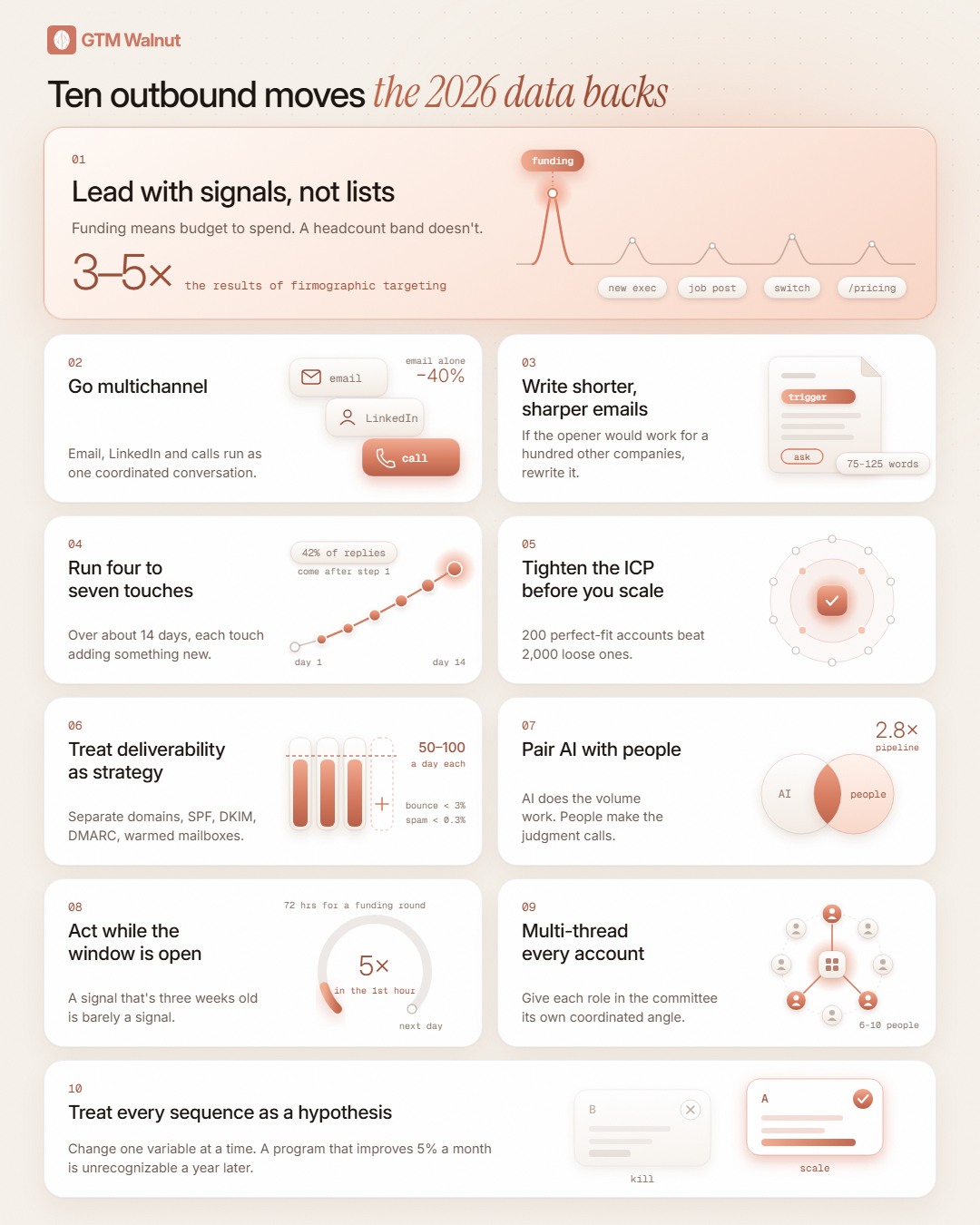
The highest-leverage shift in outbound is to stop sending to static lists and start triggering outreach on buying signals. Instead of emailing a fixed list on a schedule, you reach out when something real happens at an account: a funding round, a new executive hire, a relevant job posting, a competitor switch, or a visit to your pricing page.
This works because relevance is now the entire game. Signal-based personalization tied to a genuine trigger outperforms firmographic targeting by three to five times, because the prospect can tell you have an actual reason to reach out rather than a filter match. A funding round, for instance, signals both new budget and pressure to deploy it, which is a far better reason to appear in someone's inbox than the fact that their company employs between 200 and 500 people.
The practical move is to pick two or three signals that genuinely predict buying for your product, monitor for them, and launch a tailored sequence the moment one fires while the signal is still fresh. This is the strategy we build first for every client, because signal capture is the foundation the other nine outbound sales strategies sit on. At GTM Walnut, we wire these triggers directly into the client's own stack so the system watches for them continuously rather than depending on a rep to notice. For the engineering behind this, see our GTM engineering guide.
2. Go Multichannel, Not Email-Only
Single-channel outbound underperforms coordinated multichannel sequences by roughly 40%, so running email alone leaves most of your pipeline on the table (source). The strategy is to sequence email, LinkedIn, and calling together so the prospect encounters you in more than one place and the outreach reads as intentional rather than automated.
A strong multichannel rhythm uses email for scale, LinkedIn engagement and messaging for warmth and context, and a call at the high-intent moment such as right after an email is opened. The channels reinforce each other: a prospect who has seen your LinkedIn activity and received a relevant email is far more likely to take your call than a cold dial out of nowhere. The sequence should feel like one coordinated conversation across surfaces, not three disconnected campaigns that happen to hit the same person.
Coordinating channels manually is where most teams fall down, because keeping email, LinkedIn, and calling in sync across hundreds of prospects is an operations problem. This is one reason we build the sequencing logic into an owned system rather than leaving it to reps to remember, so every GTM Walnut client runs genuinely coordinated multichannel outreach without the manual overhead.
3. Write Shorter, More Specific Emails
Cosmetic personalization is dead. Inserting a first name and company into a generic template now reads as spam to filters and humans alike, and reply rates on it have fallen under 1%. The outbound sales strategy that replaces it is genuinely specific, short messaging tied to a real reason for reaching out.
Keep the initial email between 75 and 125 words, use plain text rather than heavy HTML, lead with the prospect and the trigger rather than your company, and make a single clear ask. Brevity signals respect for the reader's time, and specificity proves you did your homework. A good test: if the opening line could be sent to a hundred other companies without changing a word, it is not specific enough. One sharp, relevant email beats a long, polished, generic one every time.
Writing a genuinely specific opening line for every prospect at volume is exactly the kind of work that breaks when a team tries to do it by hand. The GTM Walnut approach uses AI to draft each opener from the specific signal that triggered the outreach, then has a human review it, which is how our clients keep every email specific without a rep spending twenty minutes on each one.
4. Build Sequences of Four to Seven Touches
A single touch rarely books a meeting, and most pipeline comes from the follow-up. The data converges on four to seven touches as the sweet spot, with roughly 42% of replies coming from steps after the first message. Fewer than four gives up before follow-ups can work; more than nine adds spam risk with little upside.
The strategy is a deliberate multichannel sequence spread across about 14 days, where each touch adds something rather than just bumping the thread. A follow-up that shares a relevant case study, references a new signal, or reframes the value proposition earns replies that a bare "just following up" never will. Each touch should be able to stand on its own, so that a prospect who only reads the third email still gets a complete, relevant reason to respond.
The structure matters as much as the count. We design every sequence so the touches escalate in specificity and switch channels at the right moment, and because the whole cadence lives in one system, GTM Walnut clients can see exactly which touch in the sequence is producing replies and tune from there rather than guessing.
5. Tighten Your ICP Before You Scale
The most common cause of outbound failure is not bad copy but bad targeting. No message rescues outreach sent to the wrong person. The strategy is to define your ICP with real precision before scaling volume: industry, company size, tech stack, growth stage, the specific buyer and champion roles, and the trigger events that signal a buying window.
Tighter targeting lifts every downstream metric. When your list is genuinely well-matched, the same copy that failed on a broad list suddenly converts, because relevance is built into who you are reaching rather than bolted on through personalization tokens. Narrow the ICP, then expand only once the motion is working. It is far better to run a flawless sequence against 200 perfect-fit accounts than a mediocre one against 2,000 loosely-matched ones.
Getting the ICP right is the first thing we do with a new client, before a single email goes out, because every other strategy compounds off it. GTM Walnut treats ICP definition as an engineering input, not a slide, so the targeting feeds directly into the signals the system monitors.
6. Protect Deliverability as a First-Class Priority
Open rate is a property of your deliverability, not your copy, so the best email in the world produces nothing if it lands in spam. Treating deliverability as core strategy rather than an afterthought is what separates outbound programs that scale from those that quietly die.
The strategy is to use dedicated sending domains separate from your main domain, authenticate every domain with SPF, DKIM, and DMARC, warm up every mailbox before sending cold volume, and cap sends at 50 to 100 per mailbox per day, scaling through more mailboxes rather than more volume per mailbox. Keep bounce under 3% and spam complaints under 0.3% (Google sender guidelines). This infrastructure discipline is unglamorous and decisive, and it is the single most common thing we see growth-stage teams get wrong.
Deliverability is pure infrastructure work, which is why it belongs in a built system rather than a rep's checklist. GTM Walnut stands up the full sending foundation, dedicated domains, authentication, warm-up, and inbox-placement monitoring, as part of every engagement, because a brilliant signal-based sequence that lands in spam is worth nothing. For how deliverability fits the wider motion, see our cold email guide.
7. Use the Hybrid AI Model
The 2026 evidence is clear that fully autonomous AI outbound underperforms while a hybrid human-in-the-loop model wins, with hybrid teams generating about 2.8 times more pipeline than teams using neither well. The strategy is to let AI handle the volume work and humans handle the judgment.
In practice, AI does prospecting, account research, enrichment, and first-draft personalization at scale, while humans review and qualify meaningful replies, manage relationships, and handle high-value accounts. This division lets a small team produce the output of a much larger one without sacrificing the relevance and brand judgment that fully automated blasting destroys. The mistake at both extremes is the same: treating outbound as either a pure headcount problem or a pure automation problem, when the winning model is a deliberate split between the two.
Leverage, not replacement, is the goal, and the hybrid model is the core of how we build. GTM Walnut puts AI on the research, enrichment, and first-draft work and keeps humans on qualification and high-value accounts, which is how our clients run the output of a large SDR team with a fraction of the headcount. For a full breakdown of where AI fits, see our AI SDR guide.
8. Prioritize Speed to Lead and Speed to Signal
Timing compounds everything else. On inbound signals, leads followed up within one hour convert at roughly five times the rate of next-day follow-ups (Harvard Business Review), and the same urgency applies to outbound signals: reaching out within 72 hours of a funding round or executive hire dramatically outperforms acting a week later.
The strategy is to build routing and alerting so that a fired signal or a positive reply triggers immediate action rather than sitting in a queue. The buying window a signal opens is narrow, and the team that acts while it is open wins the conversation the team that waits loses. A signal that is three weeks old is barely a signal at all, because by then your competitors have reached the same account and the trigger event has gone cold.
Speed is impossible to sustain manually, because a human cannot watch for signals around the clock. This is where a built system earns its keep: GTM Walnut wires signal detection to automated routing so the outreach fires within the window rather than whenever a rep next checks a dashboard, turning speed to signal from an aspiration into a property of the system.
9. Multi-Thread Your Target Accounts
B2B purchases involve a buying committee of six to ten people, so reaching a single contact leaves most of the decision out of the conversation. Multi-threading, reaching several relevant stakeholders at the same account with coordinated but distinct messaging, closes faster and at higher rates than single-contact outreach.
The strategy is to map the buying committee at priority accounts and tailor the angle to each role: the economic buyer hears the ROI case, the technical evaluator hears the implementation case, the end user hears the day-to-day case. Coordinated multi-threading also means that if one contact ignores you, another may engage, so the account does not fall out of the funnel on a single non-response. The key word is coordinated, because three reps hitting the same account with three unrelated messages does more harm than a single well-placed email.
Mapping committees and coordinating distinct messaging across them is an operations problem at scale, and it is one the GTM Walnut system handles by treating the account, not the contact, as the unit of outreach, so multi-threading is built into how sequences are structured rather than left to a rep's memory.
10. Treat Every Sequence as a Hypothesis
The teams that improve fastest treat outbound as a system of experiments rather than a fixed playbook. Every sequence, subject line, signal, and channel mix is a hypothesis to test, measure against a benchmark, and either scale or kill. This experimental cadence is why teams with real outbound infrastructure run several times more tests per quarter than those without.
The strategy is to change one variable at a time, measure on positive reply rate and meetings booked rather than vanity metrics, and build on what the data shows rather than what sounds clever. Outbound is never finished; it compounds for the teams that keep tuning it and stagnates for the teams that set it and forget it. The compounding is the whole point: a program that improves 5% a month is unrecognizable a year later, while one that runs the same sequences all year slowly decays as the market adapts.
Running disciplined experiments requires clean measurement, which requires a system that tracks the full funnel in one place. Because GTM Walnut builds that measurement into the engine itself, our clients can treat every sequence as a hypothesis with real data behind it rather than relying on a rep's sense of what is working.
Putting the Strategies Together
These ten outbound sales strategies are not a menu to pick from but a system that reinforces itself. Signal-based targeting feeds specific copy, which runs through multichannel sequences on protected deliverability infrastructure, with AI handling volume and humans handling judgment, all measured and iterated continuously. Pull out any one piece and the others weaken: perfect copy on bad deliverability is invisible, a great signal acted on three weeks late is wasted, and a flawless sequence against the wrong ICP converts no one.
That system view is exactly why outbound has become a build problem rather than a hiring problem. The strategies above require monitoring signals, enriching accounts, maintaining deliverability, coordinating channels, and tuning continuously, which is real infrastructure work. Many growth-stage B2B companies now choose to have that system built for them rather than assembling it through trial and error over many quarters.
GTM Walnut builds the full outbound system for Seed to Series C B2B SaaS and services companies, putting every strategy above into one owned engine: signal capture, enrichment, AI-personalized multichannel outreach with human oversight, and the deliverability foundation, delivered on the client's own stack in an average of 90 days. Client results include $15M+ pipeline in eight months for a Series A company and 270+ SQLs in nine months for an HR Tech company. Because the system is built on your own infrastructure, you own it rather than renting pipeline that stops the day you stop paying.
Why Choose GTM Walnut to Build Your Outbound System
The benefit for a customer is simple: instead of spending four to six quarters assembling these ten outbound sales strategies through trial and error, hiring for each piece, and discovering the deliverability and coordination problems the hard way, you get the whole engineered system running on your own stack in roughly 90 days. You keep the infrastructure, the data, and the institutional knowledge, because it was built on your side from the start. For a growth-stage team that needs predictable pipeline without building an outbound function from scratch, that is the difference between renting results and owning a machine that compounds.
Conclusion
The outbound sales strategies that work in 2026 all flow from one principle: relevance beats volume. Signal-based targeting, specific short copy, four-to-seven-touch multichannel sequences, tight ICP definition, deliverability as a first-class priority, the hybrid AI model, speed to signal, multi-threading, and continuous experimentation are not independent tactics but parts of one reinforcing system, and each section above showed why pulling out any single piece weakens the rest.
That system view is why outbound has shifted from a hiring problem to a build problem. Running these strategies well requires real infrastructure, which is why the teams pulling ahead treat outbound as an engineered system rather than a volume of activity.
For Seed to Series C B2B SaaS and services companies that want these outbound sales strategies built into one owned system rather than assembled piecemeal, GTM Walnut delivers the full outbound engine on your own stack in an average of 90 days, with $320M+ in total pipeline generated across 40+ engagements. You get the system, you own the infrastructure, and you keep compounding on it long after the build is done.
Book a 30-minute system audit to see what an outbound system looks like for your stage and ICP.
For the foundational guide, see our outbound sales guide. For the signal-based engineering behind these plays, see our GTM engineering guide. For the inbound side of pipeline, see our B2B lead generation guide.
The single best outbound sales strategy is signal-based prospecting: triggering outreach when a prospect shows a real buying signal (funding, executive hire, relevant job posting, pricing page visit) rather than emailing a static list on a schedule. Signal-based personalization outperforms firmographic targeting by three to five times because it proves a genuine reason for reaching out. That said, the strategies work as a system: signal targeting, specific short copy, multichannel sequences, protected deliverability, and the hybrid AI model reinforce each other, and pulling out any one weakens the rest.
Four to seven touches is the proven sweet spot for outbound sequences in 2026, spread across roughly 14 days, because about 42% of replies come from steps after the first message. Fewer than four gives up before follow-ups can work, while more than nine adds spam risk with little additional return. The key is that each touch should add something, a new signal, a relevant case study, a reframed value proposition, rather than just bumping the thread with "following up," and the strongest sequences coordinate across email, LinkedIn, and calling.
Yes, cold calling has actually regained ground in 2026 precisely because so few reps still do it well, which makes the channel less crowded. The strategy that works is using calls as a follow-up to a warm signal or an opened email rather than as a blind first touch to a random list. A call placed after a prospect has engaged with your content or email converts at a far higher rate than a cold dial. Calling works best as one coordinated channel within a multichannel sequence, not as a standalone motion.
The answer is the hybrid AI model: let AI handle research and first-draft personalization at volume while humans provide oversight and handle the replies that matter. AI can research an account and reference a genuine signal (funding, hiring, tech stack) across hundreds of prospects, which is real personalization rather than a first-name token. Cosmetic personalization that just merges in a name has collapsed to under 1% reply rates. Genuine signal-based personalization tied to a real trigger is what scales, and the hybrid model is how you produce it at volume without the quality collapse of fully automated blasting.
Focus on positive reply rate and meetings booked rather than vanity metrics like emails sent or open rate. Positive reply rate, the share of replies that are genuinely interested, is the real leading indicator of pipeline. Meeting booked rate should run 50 to 70% of positive replies, and cost per meeting ($150 to $400 for a well-run motion) measures system efficiency. Also watch bounce rate (under 3%) and spam complaints (under 0.3%) as early deliverability warnings. Measuring the right things lets you diagnose whether a weak result is a targeting, copy, or deliverability problem.
GTM Walnut builds the full outbound system for Seed to Series C B2B SaaS and services companies, putting all ten of these outbound sales strategies into one owned engine on the client's own stack in an average of 90 days. That means signal capture, waterfall enrichment, AI-personalized multichannel outreach with human oversight, and the complete deliverability foundation, all built, integrated, and handed off rather than rented. Clients have seen $15M+ in pipeline in eight months and 270+ SQLs in nine months, and because the system runs on their own infrastructure, they own it permanently. For teams that want these strategies working together as a system rather than assembled piecemeal, it removes the four-to-six-quarter build.
GTM Walnut is an AI-native GTM engineering partner that builds the full B2B marketing and pipeline infrastructure for Seed to Series C companies. Unlike traditional B2B marketing agencies that run campaigns on their own systems, GTM Walnut implements the entire stack on your infrastructure: content and AI SEO for inbound pipeline, outbound automation for signal-triggered outreach, CRM RevOps for pipeline attribution, and intent signal capture to surface in-market accounts before they fill out a form.
Clients have generated $15M+ pipeline in eight months, 450+ MQLs in 14 months, and 270+ SQLs in nine months across different verticals. The system is yours to own and operate from day one, which means you build a compounding pipeline asset rather than a recurring agency dependency. Book a 30-minute system audit to see what the build looks like for your ICP and stage.
Fixed monthly retainer, starting at $2,500/month and scaling with scope. Most engagements land between $2,500 and $6,000/month depending on email volume, channel mix, geos, and whether CRM/RevOps work is included.
We don't do pure outcome-based pricing because infrastructure, list building, and messaging cost the same regardless of meetings booked, and outcome-only models tend to push agencies toward shortcuts that wreck your domain. We do stand behind the outcomes we forecast in the proposal; it's just not the billing mechanism.
Soumya is a B2B SaaS GTM and demand-generation leader who has built multi-million-dollar pipelines for early-stage and growth companies. She led GTM programs at Y Combinator and now runs GTM Walnut, an AI-native revenue infrastructure firm working with 40+ B2B SaaS and services teams.