B2B Lead Generation: How to Generate Qualified Leads in 2026
In this guide, we cover what B2B lead generation actually is, how the process works end to end, which strategies are producing results in 2026, and how to measure whether what you're doing is working. We'll also walk through the in-house vs. outsourcing decision so you can go into that conversation with clear criteria.

If you run sales or marketing at a B2B company, B2B lead generation is the one thing that sits under every other growth conversation. Hire more SDRs? You need leads. Improve close rate? Starts with lead quality. Scale into a new market? Still about leads.
And yet, for most teams, the lead generation machine is either unpredictable, leaking qualified prospects, or quietly optimized for the wrong metric: volume over pipeline.
In this guide, we cover what B2B lead generation actually is, how the process works end to end, which strategies are producing results in 2026, and how to measure whether what you're doing is working. We'll also walk through the in-house vs. outsourcing decision so you can go into that conversation with clear criteria.
What Is B2B Lead Generation?
B2B lead generation is the process of identifying businesses that fit your ideal customer profile, capturing their contact information, and moving them into your sales pipeline as qualified prospects.
It sounds straightforward, but there's a lot packed into that definition. The "identifying" part is where most companies still work from static lists and gut instinct. The "qualified" part is where most handoffs between marketing and sales break down. And the "pipeline" part is where attribution disappears and no one can prove what actually drove revenue.
A lead, at its most basic, is a person or account that has shown some form of interest in what you sell. That interest can be explicit (they filled out a demo request) or inferred (they visited your pricing page three times this week). Sales and marketing teams use lead scoring to assign weight to these signals and decide when a prospect is ready for an actual sales conversation.
The goal of B2B lead generation is not to collect contacts. It is to build a repeatable system that reliably surfaces accounts that can buy, at the moment they're most likely to engage.
B2B vs. B2C Lead Generation: Key Differences
The word "lead" gets used the same way in B2B and B2C, but the mechanics are almost entirely different.
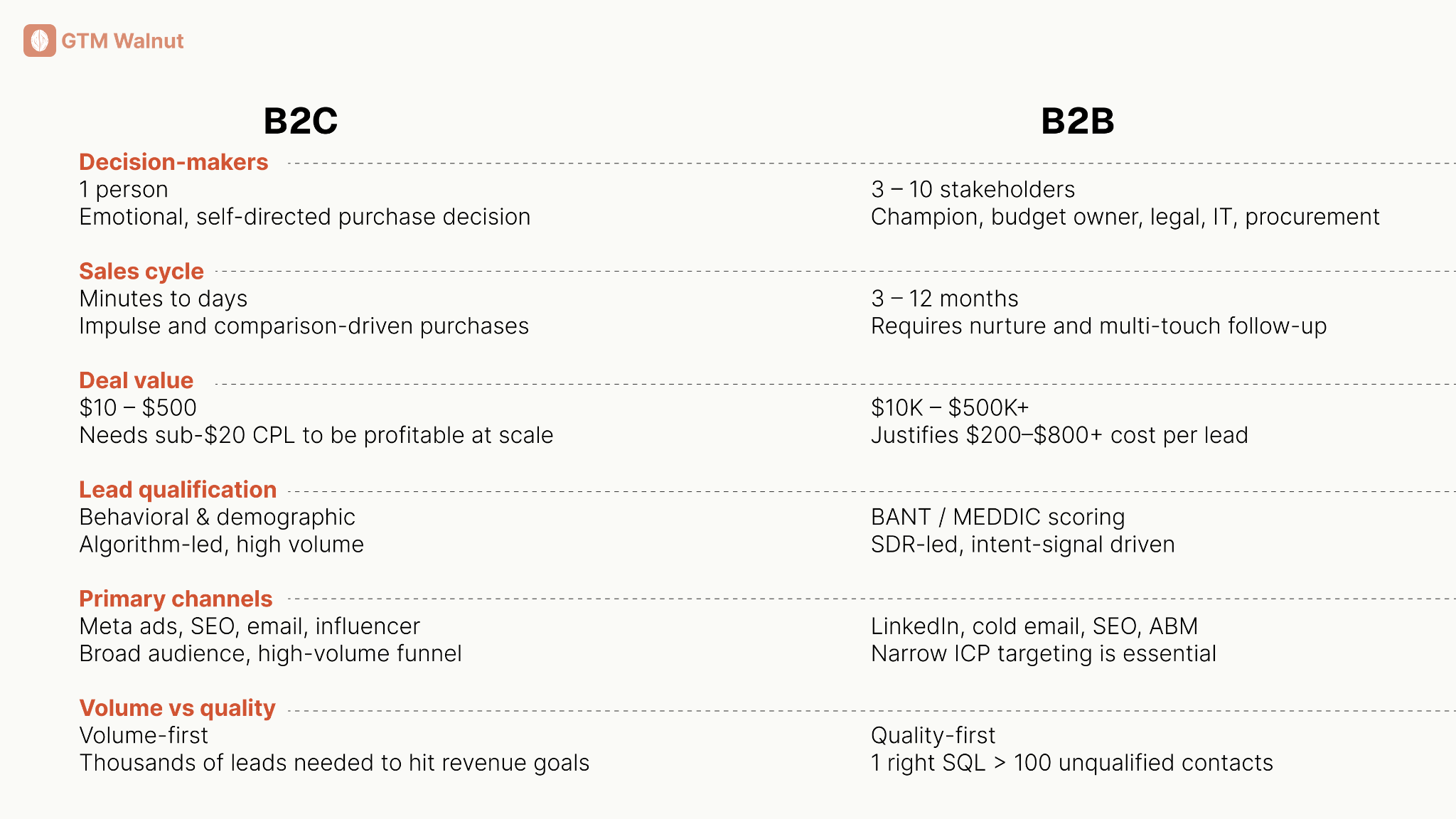
In B2C, you're typically selling to one person. The decision is often emotional, the cycle is short, and volume is the game. A retail brand can generate thousands of leads a day from Facebook ads at $5–$15 each and close them through an e-commerce flow with no sales rep involved.
B2B doesn't work like that. Here's what makes it different:
Multiple decision-makers. Most B2B purchases involve three to ten stakeholders: a champion, a budget owner, legal, IT, and sometimes a procurement layer. You're not convincing one person. You're building consensus across a buying committee.
Longer sales cycles. B2B sales cycles typically run three to twelve months, sometimes longer in enterprise. That means lead generation has to account for nurture, not just capture.
Higher deal values. Average B2B deal sizes justify significantly higher cost per lead. A $50K ACV contract makes a $500 CPL entirely defensible. A $30 consumer product does not.
Intent is harder to read. B2C buyers raise their hand clearly (they add to cart, they click "buy now"). B2B buyers research quietly for weeks before surfacing. Getting signal on that dark funnel activity requires different tools and different strategy.
ICP specificity. B2C audiences can be broad. B2B lead generation works best when you're targeting a narrow ICP, a specific industry, company size, tech stack, growth stage, or trigger event. The tighter the ICP, the better the conversion.
Why B2B Lead Generation Matters in 2026?
Lead generation has always mattered. What's changed is what you're competing against.
The median B2B cost-per-lead hit $213 in Q1 2026, up from $198 in 2025. That number has been climbing for three straight years, driven by rising paid media costs, cookie deprecation, and the fact that AI-generated content has flooded every channel that used to convert cheaply on content alone.
At the same time, the gap between the best and the rest has widened dramatically. The top quartile of B2B demand gen teams now converts MQL to SQL at more than twice the median rate, and pays roughly half the CPL for the same pipeline output. The difference isn't budget. It's whether they're running a system or running campaigns.
The teams winning pipeline in 2026 are the ones who:
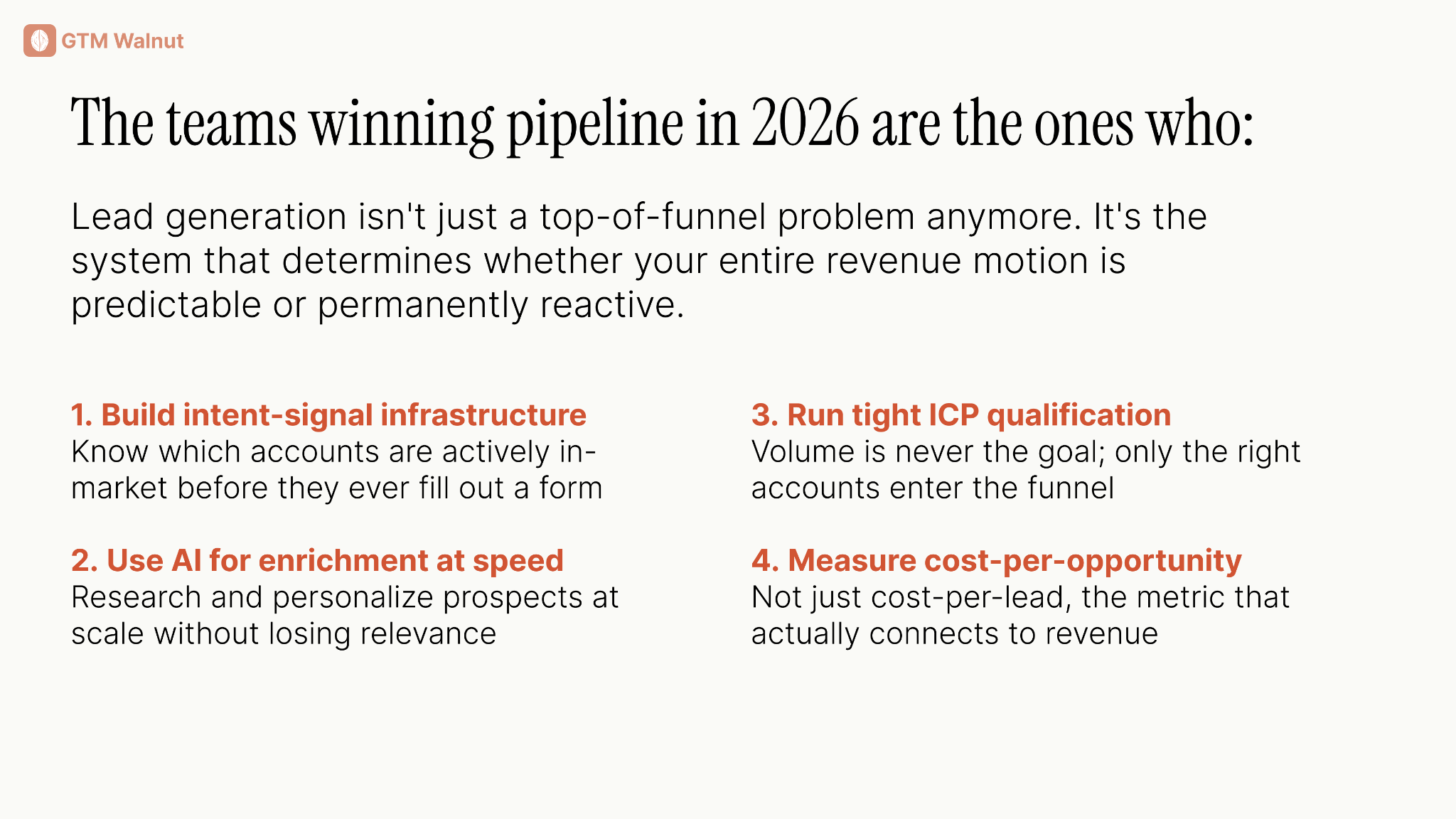
- Build intent-signal infrastructure to know which accounts are actively in-market before they ever fill out a form
- Use AI to enrich and research prospects at speed without losing personalization
- Run tight ICP qualification so that volume is never the goal
- Measure cost-per-opportunity, not just cost-per-lead
Lead generation isn't just a top-of-funnel problem anymore. It's the system that determines whether your entire revenue motion is predictable or permanently reactive.
Types of B2B Leads: Cold, Warm, MQL, and SQL
Not all leads are equal, and treating them the same is one of the fastest ways to burn out a sales team.
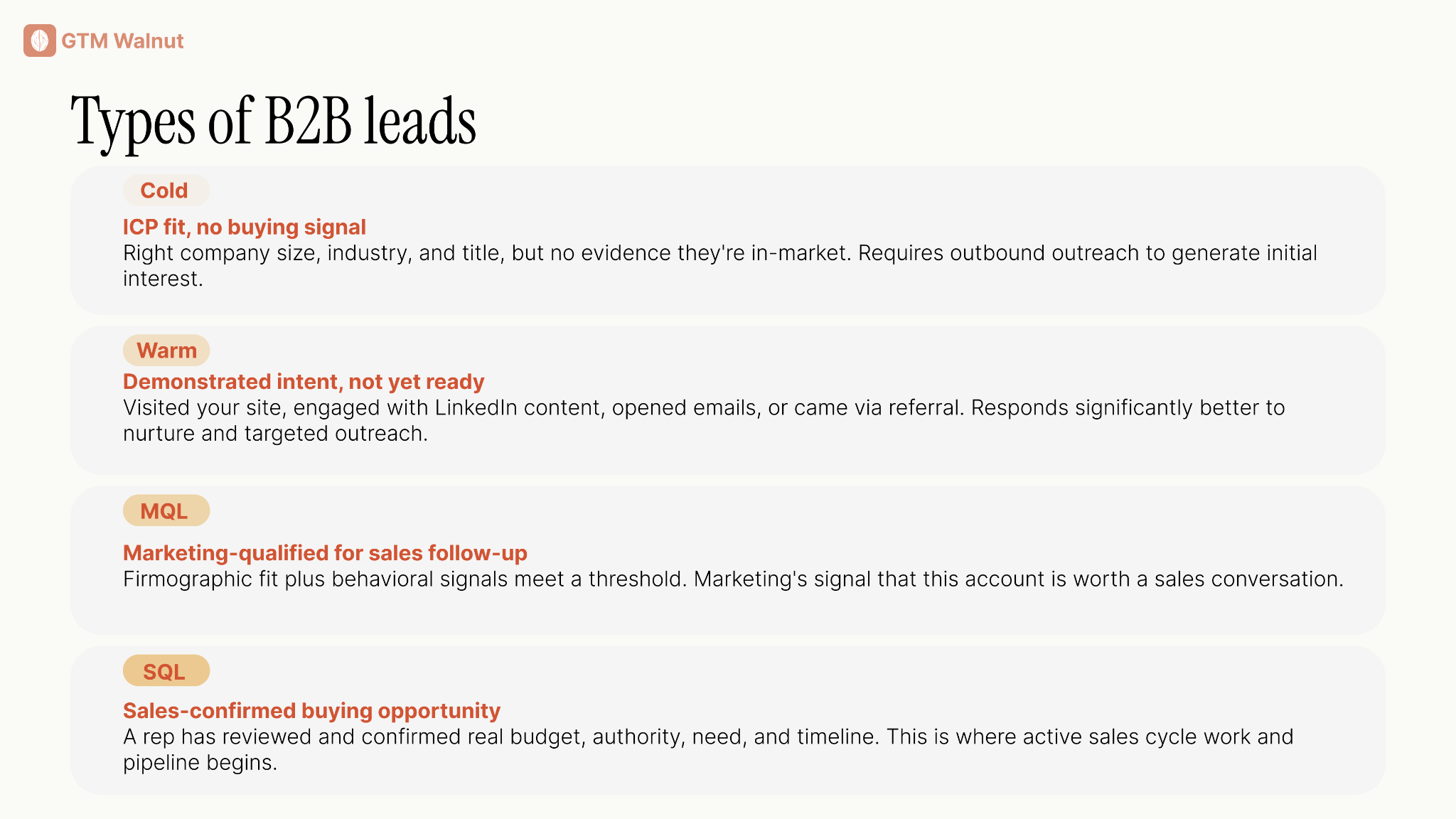
Cold leads are contacts who match your ICP but haven't shown any buying signals. They fit the profile on paper: right company size, right industry, right job title, but there's no evidence they're in-market. Cold leads require outbound outreach to generate initial interest. They convert at lower rates, but at scale they fill the top of the funnel when inbound isn't enough.
Warm leads are contacts who have demonstrated some level of intent. They've visited your website, engaged with your LinkedIn content, opened your emails multiple times, or been referred by a mutual connection. They're not ready to buy, but they're not cold either. Warm leads respond to nurture sequences and targeted outreach significantly better than cold contacts.
Marketing Qualified Leads (MQLs) are leads that marketing has evaluated and determined meet a threshold for sales follow-up. The criteria vary by company, but typically include a combination of firmographic fit and behavioral signals (content downloads, webinar attendance, pricing page visits, demo requests). An MQL is marketing's way of saying: "This one is worth a sales conversation."
Sales Qualified Leads (SQLs) are leads that a sales rep has reviewed and confirmed as a genuine buying opportunity. The qualification typically follows some version of BANT (Budget, Authority, Need, Timeline) or MEDDIC. An SQL is where real sales cycle work begins.
The MQL-to-SQL handoff is the most common failure point in B2B lead generation. The cross-industry average MQL-to-SQL conversion sits at around 13%. Top-performing teams get above 28%. The gap comes down to lead scoring rigor, ICP alignment, and whether sales and marketing agree on what "qualified" actually means.
7 Step by Step Process of B2B Lead Generation
Here's how to do B2B lead generation in a way that actually produces pipeline, not just spreadsheet entries.
Step 1: Define your ICP
Before you generate a single lead, you need to be specific about who you're targeting. Industry, company size (revenue or headcount), geography, tech stack, growth stage, and the job title of your buyer and your champion. Vague ICPs produce vague results.
Step 2: Build your target account list
Use your ICP to build a list of accounts. This can come from intent data platforms, funding databases, technographic providers, or manual research. The more signal you can attach to each account (recent job hires, funding, product launches, competitor usage), the better your outreach will convert.
Step 3: Enrich contact data
Find the right people at those accounts. Verify email addresses and LinkedIn profiles. Bad data is a silent CPL killer — teams with verified contact lists see significantly lower bounce rates and higher reply rates than those working from unvalidated lists.
Step 4: Attract or generate interest
This is where inbound (SEO content, LinkedIn thought leadership, webinars, paid ads) and outbound (cold email, LinkedIn outreach, calling) intersect. Most B2B companies doing serious volume run both simultaneously.
Step 5: Capture and qualify
Move interested prospects into a qualification flow. This might be a form on a landing page, a conversation with an SDR, or a chatbot on your pricing page. Score them against your ICP and their behavior. Pass qualified leads to sales.
Step 6: Nurture the gap
Most leads aren't ready to buy when you first touch them. B2B buying cycles are long. Build nurture sequences that keep your brand present and deliver useful content until the timing is right.
Step 7: Measure and optimize
Track conversion rates at each stage, cost per qualified lead by channel, and ultimately pipeline and revenue contribution. Use that data to cut what isn't working and double down on what is.
What are the B2B Lead Generation Strategies for 2026?
There's no single channel that works for every B2B business. The companies generating the most pipeline run a coordinated mix of inbound and outbound, calibrated to their deal size, sales cycle, and ICP.
Inbound and SEO
Inbound lead generation means building content and authority that brings buyers to you, instead of you chasing them.
SEO is the long game. A pillar page on a high-volume keyword in your category can generate qualified traffic for years at a fraction of the CPL of paid channels. Once established, organic leads cost roughly $15-$60 per lead versus $80-$180 for LinkedIn ads and $50-$150 for Google paid search.
The catch is time. Inbound SEO takes four to nine months to generate meaningful volume. It's not a Q1 quick win, but it's the highest-leverage investment for sustainable CPL reduction over a two to three year horizon.
In 2026, AI overviews and AEO (Answer Engine Optimization) have changed organic traffic patterns. Content that answers questions directly and earns citations in AI summaries is capturing demand that would have gone to paid channels two years ago. Teams building content-led inbound systems are insulating themselves from the paid CPL inflation hitting everyone else.
Cold Email and Outbound
Outbound is still the fastest way to generate pipeline from scratch. A well-structured cold email sequence targeting verified contacts at ICP-fit accounts can produce booked meetings in the first two weeks of a new campaign.
What's changed in 2026 is the bar for personalization. Generic, spray-and-pray sequences don't get replies; they get spam filters. The sequences that convert precise targeting (right company, right trigger event, right contact) with relevant, specific messaging that shows you've done your homework.
The benchmarks for healthy cold email outreach sit at 36-48% open rates, 6-10% reply rates, and 3-6% lead-to-meeting conversion. If you're below that, the issue is usually one of three things: deliverability, list quality, or copy relevance.
AI-assisted SDR programs have meaningfully changed the economics here. Recent benchmark studies showed AI-assisted outreach reducing cost-per-meeting from $312 to $94, driven by faster research, better personalization at scale, and smarter send-time logic. The best outbound teams in 2026 use AI to draft and personalize, with humans reviewing before send, not fully automated blasting.
LinkedIn Lead Generation
LinkedIn drives up to 80% of all B2B social leads. It is still the best platform for reaching business decision-makers, full stop. But the tactics that worked in 2023 are actively penalized today.
LinkedIn's algorithm now suppresses high-volume, low-engagement outreach. The shift is from volume to signal quality. Inbound-led outbound, where your content builds visibility and warm context before you ever send a message, now converts at roughly 14.6%, compared to 1.7% for cold connection requests.
The practical implication: don't use LinkedIn as just another outbound channel. Use it as a warm-up layer. Your SDRs should be engaging with prospects' content, your founders and sales leaders should be posting consistently, and your outreach should follow genuine engagement, not precede it.
For high-volume LinkedIn outreach at scale (multi-sender campaigns across a team), tools like HeyReach allow coordinated outreach that doesn't rely on a single account's connection limits. The key is that messaging still needs to be specific and relevant.
Account-Based Marketing (ABM)
ABM flips the lead generation model. Instead of generating a broad pool of leads and qualifying down, ABM starts with a list of target accounts and builds a coordinated marketing and sales motion around each one.
It works exceptionally well for enterprise sales with long cycles and multiple stakeholders, where you need to reach several people at the same company with tailored messaging. The tradeoff is resource intensity as ABM at scale requires content, ads, outreach, and sales coordination all pointed at the same accounts simultaneously.
A light version of ABM that many mid-market companies run successfully is the "1-to-few" model: a list of 20–50 high-priority accounts gets dedicated sequences, personalized landing pages, and direct outreach, without the full enterprise ABM build-out.
Paid, Events, and Referrals
Paid search generates high-intent traffic because buyers are actively searching for solutions. Average CPL on Google Ads for B2B runs $50–$150, but in competitive categories it can climb well above that. The advantage is immediacy as paid search turns on fast and gives you signal quickly.
Events and webinars, both virtual and in-person, still generate some of the highest-quality leads in B2B. A prospect who shows up to your webinar and stays for 40 minutes is demonstrably interested. The conversion-to-meeting rate from event leads consistently outperforms cold list contacts.
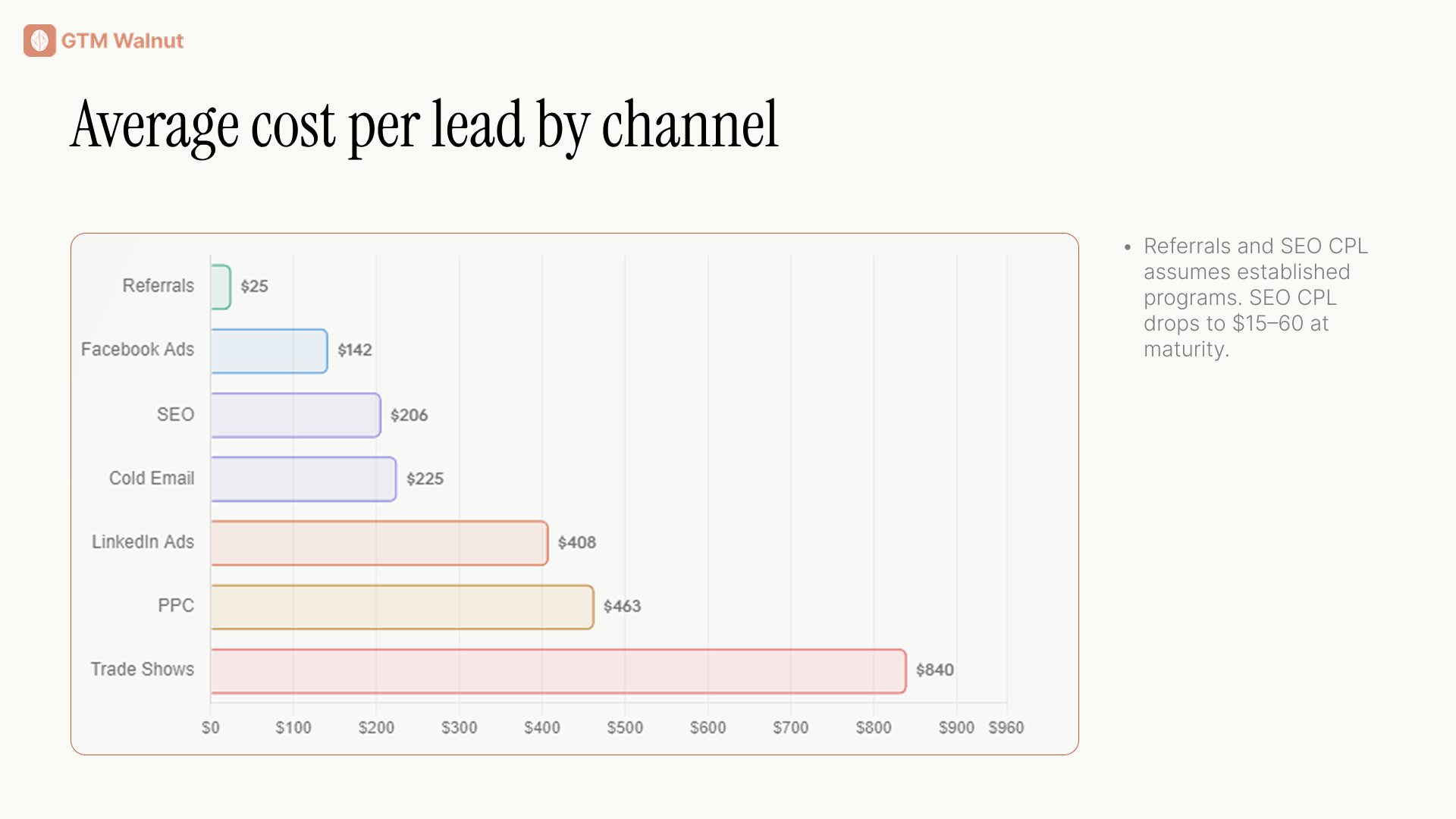
Referrals have the best CPL by a wide margin with benchmarks putting average referral CPL at $25 versus $225 for cold email and $408 for LinkedIn ads. Building a structured referral program with your existing customers and partners is one of the most underused lead generation levers in B2B.
How to Generate Leads for B2B Sales?
Generating leads for the sales team specifically (as opposed to marketing-driven pipeline) requires a slightly different emphasis. Sales teams need warm, fast-moving leads — not content downloads that need six months of nurture.
Here's what actually works:
Trigger-based prospecting
Monitor for signals that indicate buying intent: new funding rounds (companies spending on infrastructure), executive hiring (new VP of Sales or CMO often signals new vendor evaluation), product launches (competitive displacement opportunity), job postings (signals growth and pain points). Reaching out within 72 hours of a trigger event dramatically outperforms static list outreach.
Multi-threaded outreach
Don't just reach out to the champion. Map the full buying committee at priority accounts and reach out to multiple stakeholders with coordinated but distinct messaging. Multi-threaded deals close faster and at higher rates.
Sales content that pulls
Case studies, competitive comparisons, and ROI calculators don't just support late-stage deals. They generate inbound leads when distributed properly. A well-placed LinkedIn post from a founder that links to a case study with a relevant trigger event can generate five to ten warm leads in 24 hours.
Speed to lead
Inbound leads that are followed up within one hour convert at 5x the rate of leads followed up the next business day. Build your routing so that a form fill or demo request triggers an immediate sales notification and a same-hour response, not a next-day queue.
B2B Lead Generation Tools and Automation
The modern B2B lead gen stack has three layers: data, outreach, and orchestration.
Data and enrichment
Tools like Clay allow waterfall enrichment across 50+ data providers to find and verify contact information at scale. Intent data platforms surface accounts actively researching your category. Website visitor identification tools like RB2B identify the individual visitors on your site who never fill out a form.
.png)
Outreach
Email sequencing platforms (Instantly, Smartlead) handle deliverability, warm-up, and send infrastructure. LinkedIn outreach tools (HeyReach) allow multi-sender campaigns that stay within platform guidelines. CRM tools like HubSpot and Attio manage lead routing, scoring, and handoff.

Orchestration
This is the layer that connects everything - monitoring signals, triggering workflows, routing leads, and personalizing outreach at scale. Tools like n8n act as the workflow backbone. AI agents (built on Claude Code or similar) handle research, drafting, and routing logic that used to require multiple human SDRs.
If you're building your stack from scratch, start with your CRM, add an enrichment layer, and build outreach infrastructure from there. Don't buy ten tools before you have a clear ICP and a working outbound sequence. Tools don't fix a strategy problem.
Teams that want to skip the build-entirely-yourself phase are increasingly working with GTM engineering partners like GTM Walnut, who design and implement the full AI GTM stack — from signal capture through outreach automation — as a done-for-you system. The advantage is getting a proven stack running in 90 days versus building it incrementally over a year. For a full breakdown of the best providers, see our B2B lead generation agencies guide.
How to Measure B2B Lead Generation: Conversion Rate, CPL, and Beyond
Volume metrics will get you fired. Pipeline metrics will get you promoted.
Here's how to measure B2B lead generation properly:
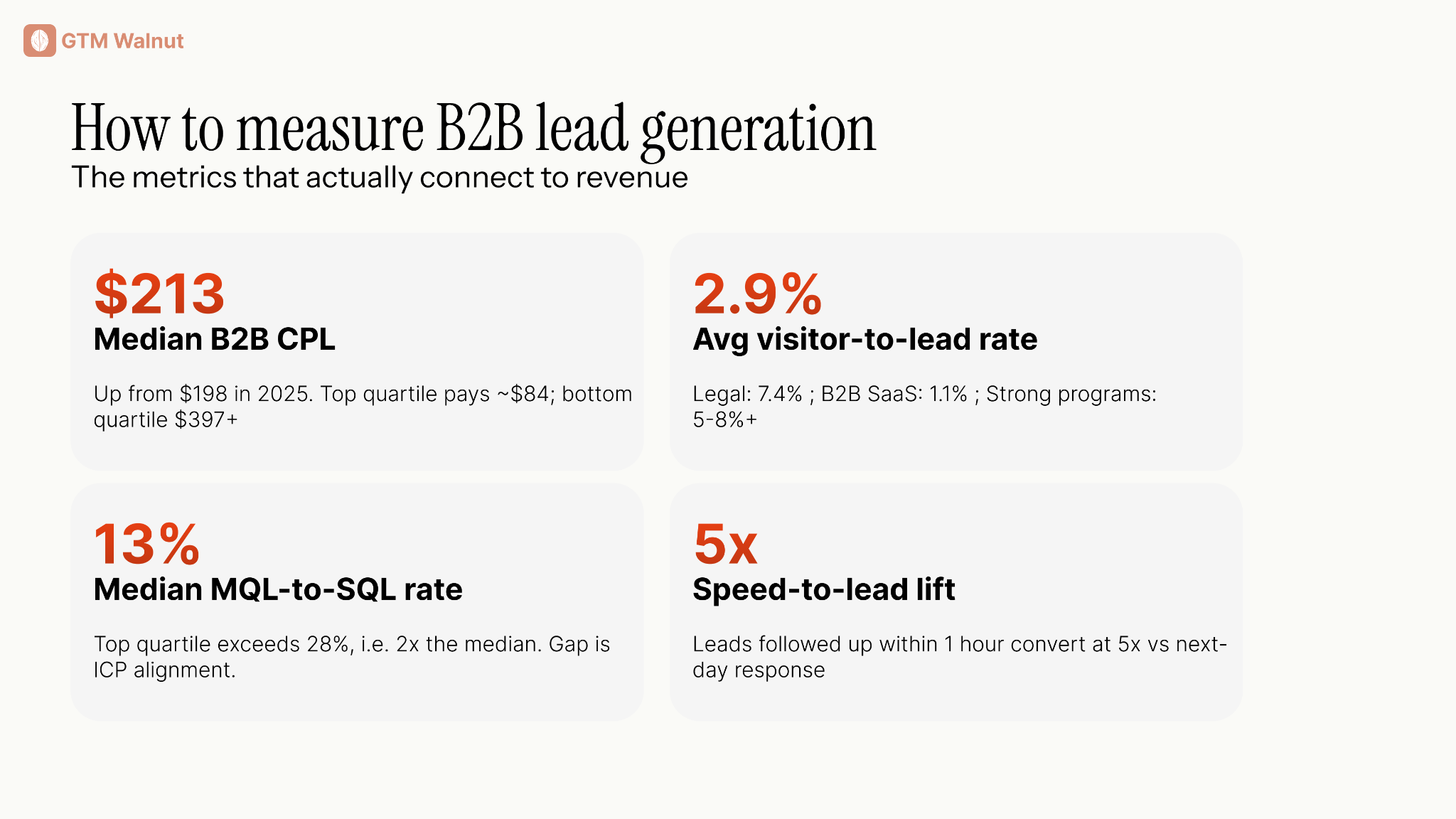
- Cost per lead (CPL). Total spend divided by number of leads generated. The median B2B CPL in 2026 is $213, but this varies enormously by channel (referrals at $25 vs. trade shows at $840) and by how tightly you define "lead." Always track CPL by channel so you can make allocation decisions.
- MQL-to-SQL conversion rate. The industry median is around 13%. If yours is significantly lower, the problem is usually lead quality or a misalignment between what marketing considers "qualified" and what sales can actually close.
- SQL-to-Opportunity conversion rate. What percentage of sales-qualified leads turn into active pipeline? This is where SDR skill and sequence quality show up in the numbers.
- Cost per opportunity. Total lead generation spend divided by number of opportunities created. This is the number that actually connects your marketing investment to revenue. It's more useful than CPL because it accounts for quality, not just volume.
- Lead-to-close rate by channel. Some channels produce leads that close at 20%. Others produce leads that close at 2%. Knowing which is which determines where you invest.
- Website visitor-to-lead conversion. The cross-industry average is 2.9%. B2B SaaS typically sits at 1.1%, legal services at 7.4%. Benchmarking your rate against your category tells you whether optimization work on your landing pages is worth the investment.
A word on conversion rates and what "good" looks like: a strong B2B lead-to-opportunity conversion rate typically falls between 3% and 5% at the visitor level, with top-performing programs exceeding that through better targeting, faster follow-up, and tighter ICP alignment.
In-House vs. Hiring a B2B Lead Generation Agency
At some point, most B2B companies face this question: do we build the lead generation function internally, or do we bring in an outside partner?
Here's how to think through it:
Build in-house when:
- You have the time to recruit, train, and manage an SDR team (plan 3-6 months for a new hire to ramp to full productivity)
- You have strong marketing infrastructure already in place (CRM, content, landing pages)
- Your ICP and messaging are well-defined and validated, meaning, you know what works, you just need to scale it
- Lead generation is a long-term core competency you want to own
Hire a B2B lead generation agency or partner when:
- You need pipeline faster than internal hiring allows
- You don't yet have the data infrastructure, tooling, or process to run efficient outbound
- You're entering a new market or ICP where you lack institutional knowledge
- You want to test a channel before committing to a full internal build
The third option, increasingly popular in 2026, is partnering with a B2B lead generation service that operates as a GTM engineering partner rather than a traditional outsourced SDR vendor. These partners, including our list of B2B lead generation agencies, build the infrastructure and system: signal capture, enrichment, outreach automation, CRM configuration, so that when you do hire internally, you're running a proven system, not starting from zero.
If you are also evaluating broader marketing support beyond lead generation, our B2B marketing agencies guide covers the full landscape of full-service, digital, and demand gen partners.
GTM Walnut is one such partner. Working with Seed-to-Series C B2B SaaS and services companies, they design and implement the full AI-native GTM stack: outbound automation, CRM RevOps, and content infrastructure, and wire it into a system that your team can operate from day one. Clients have built $15M+ pipeline in eight months and seen 270+ SQLs in nine months across different verticals. If you're evaluating whether to build or outsource, it's worth a 30-minute audit conversation to understand what a system build would look like for your specific motion.
B2B lead generation is the process of identifying businesses that fit your ideal customer profile, generating interest from decision-makers at those businesses, capturing their contact information, and qualifying them as sales-ready opportunities. It covers both inbound strategies (SEO, content, paid ads that bring buyers to you) and outbound strategies (cold email, LinkedIn outreach, SDR calling that take your message to the market).
The most effective B2B lead generation programs combine inbound and outbound. On the inbound side, that means SEO content, LinkedIn thought leadership, webinars, and paid search that attract buyers already looking for solutions. On the outbound side, that means building precise target account lists, enriching contact data, and running personalized multi-channel sequences (email + LinkedIn + calling) to reach buyers who fit your ICP but haven't found you yet. Signal-based prospecting, reaching out when a trigger event (funding, hiring, competitor usage) indicates buying intent, significantly outperforms static list outreach.
LinkedIn works best as a warm-up layer, not a pure outbound channel. The playbook that's producing results in 2026 involves consistent content from founders and sales leaders to build visibility with your target audience, engagement with prospects' content before initiating outreach, and personalized connection requests and messages that reference something specific and relevant. High-volume generic outreach is now penalized by LinkedIn's algorithm and converts at under 2%. Inbound-led outbound (where a prospect engages with your content before you message them) converts at around 14.6%.
For sales-specific pipeline, the highest-conversion tactics are trigger-based prospecting (reaching out within 72 hours of a funding round, executive hire, or competitive displacement signal), referral programs, and direct outbound sequences at named accounts. Speed matters enormously on inbound, since leads followed up within one hour convert at 5x the rate of next-day follow-ups. Multi-threaded outreach to multiple stakeholders at the same account also significantly improves win rates compared to single-contact sequences.
The cross-industry average for visitor-to-qualified-lead conversion is 2.9%. A strong conversion rate falls between 3% and 5%, with top-performing programs exceeding 8% in some categories. MQL-to-SQL conversion averages around 13% at the industry median, with top-quartile teams hitting 28% or higher. The most useful conversion rate to track is SQL-to-close, because it connects your entire lead generation investment to actual revenue.
GTM Walnut is an AI-native GTM engineering partner that builds the full B2B marketing and pipeline infrastructure for Seed to Series C companies. Unlike traditional B2B marketing agencies that run campaigns on their own systems, GTM Walnut implements the entire stack on your infrastructure: content and AI SEO for inbound pipeline, outbound automation for signal-triggered outreach, CRM RevOps for pipeline attribution, and intent signal capture to surface in-market accounts before they fill out a form.
Clients have generated $15M+ pipeline in eight months, 450+ MQLs in 14 months, and 270+ SQLs in nine months across different verticals. The system is yours to own and operate from day one, which means you build a compounding pipeline asset rather than a recurring agency dependency. Book a 30-minute system audit to see what the build looks like for your ICP and stage.
Fixed monthly retainer, starting at $2,500/month and scaling with scope. Most engagements land between $2,500 and $6,000/month depending on email volume, channel mix, geos, and whether CRM/RevOps work is included.
We don't do pure outcome-based pricing because infrastructure, list building, and messaging cost the same regardless of meetings booked, and outcome-only models tend to push agencies toward shortcuts that wreck your domain. We do stand behind the outcomes we forecast in the proposal; it's just not the billing mechanism.
Soumya is a B2B SaaS GTM and demand-generation leader who has built multi-million-dollar pipelines for early-stage and growth companies. She led GTM programs at Y Combinator and now runs GTM Walnut, an AI-native revenue infrastructure firm working with 40+ B2B SaaS and services teams.